
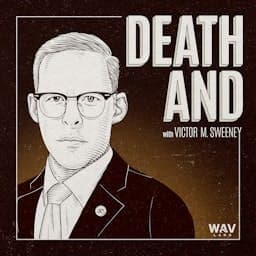



In this episode of "Death And," mortician Victor M. Sweeney welcomes psychologist and author Dr. Liz Scott to grapple with the big question of death and what comes next. The conversation revolves around the concept of “annihilation” and the fear of nothingness after death, contrasting Victor’s steady belief in an afterlife with Dr. Scott’s journey from near-terror to near-acceptance of mortality. They discuss Liz’s book “You're Going To Die But Not Me!” and Dr. Scott opens up about her personal experiences, including the loss of her husband and how that shaped her exploration of legacy, meaning, and what really remains after we’re gone.
http://lizscottwriter.com
https://www.powells.com/book/youre-going-to-die-but-not-me-a-psychologist-wrestles-death-9781965784372?condition=New&srsltid=AfmBOorgRtfkYO4h05LJuiJQ8EoBuXyOTf5whKPnDi59POHgxMF1Awoj
http://deathandpodcast.com
http://youtube.com/@victormsweeney
http://instagram.com/victor.m.sweeney
http://tiktok.com/@victormsweeney
http://x.com/victormsweeney
http://simonandschuster.com/books/Now-Departing/Victor-M-Sweeney/9781668062111
Learn more about your ad choices. Visit podcastchoices.com/adchoices
[00:00:00] Was deine Haut braucht, ist was deine Haut braucht. Pigmentflecken reduzieren und vorbeugen durch innovative Wirkstoffe und höchsten UV-Schutz. Eubos Anti-Age, dein neues Duo gegen Pigmentflecken und Hautalterung. Eubos, Individual Skincare. The word that kept coming to me was annihilation. That feels like a very terrifying notion to me.
[00:00:42] Death and the Void. Today's episode, I interview Dr. Liz Scott. And she's a psychologist and an author. And we've had the curious situation where she reached out to the podcast to see if we wanted to chat. In some ways, I'm very delighted. She sent me her book and I think she wants to put it out there.
[00:01:07] And in our discussion, you will find that she has a very different view than I do. If you've listened to the show for any amount of time, I'm fairly open to ideas. And I don't always like to put a very hard and fast label on it. But the fact is, I believe in the afterlife. And I believe in the immortality of our animating principles.
[00:01:36] And as such, I don't really have that much to fear. Even if I took the fully stoic view that there's nothing after this, why should I be afraid? Everyone has gone before me, has gone before me, and done the very thing that we are discussing. They've died. I'm your host, Victor M. Sweeney, and this is another episode of DEATH AND I'm glad you're here with me.
[00:02:05] So in our interview, I maybe push-prodded a couple times. And when we got down to the heart of it, I find that Dr. Scott and I, we share the same bond of death, don't we? Not that we're just authors about books about death, but rather she's experienced it profoundly in her life. And that is something that I understand.
[00:02:35] Part of the trick of mutual understanding is asking these questions, cutting down to the bone and finding where we have these lovely commonalities. And as a sort of adjacent idea to that, we answer questions here on the podcast. And it's something I have really grown to enjoy.
[00:02:59] I started off my journey in the media realm answering questions from Twitter, and some of them were very silly. And I think it's nice to have graduated to questions from listeners, people who actually want to know an answer or hear what I, of all people, think about a certain topic. So let's jump in and see what you lovely people have sent along the way.
[00:03:33] Okay. Okay. Ooh, interesting. Here's a question from Allison. How do those in funeral service cope with infant death, specifically stillbirth? Well, I, for one, Allison, hope that this is not a question coming from personal experience. Stillbirth is particularly hard because it really is the death of just pure potential. Hopes and dreams when you have a baby or stillbirth.
[00:04:03] I had one some years ago, and it was extremely hard because the baby was actually the same gestational age as my son. They had a birthday just weeks apart, a due date rather. My son had a birthday, and the other baby did not. And it's very interesting, at least at my funeral home, and I really think it should be all funeral homes. We don't charge anything for children or infants or stillbirths.
[00:04:30] Many hospitals will have a sort of disposition policy where they'll help families, whatever, take the baby to the crematory or something. And when the family called me, they brought this up, and I will tell you very honestly, I cried on the phone with the mom and dad. And I was actually already at the morgue when they called me back. And they're like, well, we're thinking cremation. And I said, you know,
[00:04:59] just so you know, when you cremate a body, the only thing that's left are bones. And your baby's bones at 20 weeks are so infinitesimally small, barely even connected. To cremate them, you'd get a handful of dust. It's not going to cost you anything. How about instead you let me take care of your baby, and we'll bury it alongside your family
[00:05:30] in this little body that you have spent so much time stitching together in the womb. Leave it as it is. Let it go back to nature. But don't give me a handful of dust. So it is hard. Stillbirth is hard. I remember holding that baby in my hand, knowing it's the same size as the one in the womb of my wife. And no one is unmoved by that.
[00:06:00] Even the guy who deals with it all too often. Thanks, Allison. Here's a question from Willow Maldonado. I'd like for you to take care of me when I'm gone. How can I make that happen? Well, this is the tricky thing about morticians, undertakers, funeral directors. We are strictly bound by geography. So the only way for that to happen, Willow,
[00:06:26] is for you to move up within 30 miles or so of Warren, Minnesota, which I can assure you is not a very pleasant place to live about half of the year when the snow gets to be two feet deep and the wind blows at negative 60 degrees Fahrenheit. So that is it. We are bound not only by time as creatures on this planet, but undertakers especially are bound by place. And that can be a very good thing.
[00:06:54] I know the people in my town, and I like to think that some of them are happy to know me when the time comes. But there are traveling funeral directors, but to really get a handle on it, I think you have to be connected to the place where you are. And that is just part of what my vocation is. So unless you want to pack a moving truck and come way further north than you probably want to, that is the way it is done. Thank you for the question.
[00:07:30] I want to thank you all for your questions. It's always a supreme delight to see what comes out of the woodwork and out of the backs of your minds and hearts. It's good for me to know it connects me to you in a certain way. If you want to join the club of the handful of people so far who've had their questions answered on the podcast, join our ranks.
[00:07:59] You can send your questions to deathandpodcast at gmail.com. You send it as an email. Or if you're feeling particularly brave, you can go to deathandpodcast.com where you may leave a voicemail, which is honestly so fun to hear from. When we wrapped up our review, that's generally when we pick our titles. And we were discussing, what shall we call this?
[00:08:28] Because we talk about working in a death arena. We talk about writing. We talk about a fear of death. We talk about annihilation, which is something I don't know that we stumble across too often. Maybe we don't put words to it. And maybe that is a lot of people's fear. For the most part, when I hear from folks on the web, they say, I'm not afraid of dying. I'm afraid of suffering.
[00:09:00] That very active part, the very human, meaty part of us, the suffering. And maybe if there is such thing as annihilation, that's a much more existential part, isn't it? And I wanted to summarize that without sounding, I don't know, too negative. For you listeners, we can leave the door open, although I know what I believe. So we're calling it the void.
[00:09:30] The envisioning of nothingness. But even as we envision it, it does become something. We can't even conceive of nothingness. So does it even really exist? That's maybe a question for another episode. Let's jump into a discussion about the void.
[00:10:32] I want to welcome onto the Death & Podcast today, Liz Scott. She is a practicing psychologist in Portland, Oregon and the author of a book, You Are Going to Die, But Not Me! with an exclamation mark. She's written some other books and had a long, a 40-year career in psychology. Yeah. And I want to welcome you to the show. Liz, thanks for being here. Thank you so much for having me, Victor. It's a pleasure. Well, I'll tell you what. You reached out to me. I did. And you said,
[00:11:01] Victor, I would like to chat with you and here's a PDF of my book. And so I got to read the advanced reader copy, which is kind of fun. It's interesting to be in on the ground floor of a thing. But tell us, when does your book come out? Actually, the book is out. The book is out. I had my launch last night at Powell's Bookstore, which is a real institution here in Portland. It's a wonderful full-block bookstore. Oh, nice.
[00:11:31] Yeah, it's an amazing place. It's just a thrill of a lifetime. So yeah, I had a big crowd there last night. It was really, really fun. So the crux of your book, at least by the subtitle, is that you, at least in the course of the book, you are trying to wrestle with mortality and learn to accept it. Yes? Yes. Yes. Wrestle with my terror. You know, my elevator pitch is that it's kind of
[00:12:00] my journey from near terror to near acceptance of my mortality. Yeah, so I started off at terror. And tell us, why terror? Why terror? I mean, I'm always amazed that not everybody feels this way. This is always a puzzle to me. It's really, you have much more insight into this than I do, but... I'm the opposite. I'm like, why do people worry about this stuff? Oh my gosh. You're gonna have to be my guide. Yeah, you know, it's interesting,
[00:12:31] Victor, because I think a lot of people, when they talk about a fear of death, they think about being afraid of the dying part. That is, I'll tell you what, especially in the comments on the web, that's people say, I'm not afraid about being dead. I'm just afraid about suffering or something. And I'll tell you right now, I'm a Catholic. We love suffering. We're all about suffering. We know how to do that six ways to Sunday. But you, in your book, you talk about the opposite. You actually just are afraid
[00:13:00] of nothingness. The being dead part. Yes. The being dead part. Yeah. Yeah, my husband died in 1999 and we were, we're blessed to have, he was home with hospice and, you know, hospice workers, I bow down to you. I think they all should be sainted. And I know this is not universal. I know some people suffer greatly when they're dying, but I come away with it. What might be an irrational belief that there are, there are enough kind hospice workers. There's enough morphine in the world
[00:13:28] that I'm not really afraid of the dying part, but yeah, it's the sense of the kind of, the word that kept coming to me was annihilation. Annihilation. That feels like a very terrifying notion to me. Well, what about, at least in my mind, right off the top of my head, I would say the antidote to that is legacy. Well, you know, so I went down so many rabbit holes in writing this book
[00:13:57] and so I'm sure you probably have read Ernest Becker's book, The Denial of Death, and where he talks about immortality projects and his foundational belief is that we do all sorts of things to sort of deny our mortality and to sort of paper over it. We have children, we write books, we do other things that we create a sense of meaning and all to kind of mitigate the terror that
[00:14:28] in his framing, life is basically meaningless and so we have to sort of create a sense of meaning in order to believe that we're just, that, you know, not just kind of random bunch of cells here that are gone after a minute. So do you, would you say then that your legacy then, like a part of it is your book, you have, You have two children, right? I have two children and a grandson.
[00:14:59] Okay, so there's, there's something there. What about your primary work as a psychologist? Like do you, do you find that as something that is going to last? Let's see. I, I derive so much meaning out of my work. I love my clients. I love working with my clients. I feel it's a great privilege and an honor that people, you know, trust me to open themselves up in the way they do.
[00:15:28] I adore my children. My grandson is the best person on the planet and sorry everybody else, but he just is. And by the way, I think you, didn't you live in Ireland? I did for six months. He's going to college at Trinity next fall. Okay, he's up in the pale. See, I was from what they call the Republic of Cork. Oh, the Republic of Cork. Yeah, it's like the one part of Ireland that never really gave in to the British. So there's still
[00:15:58] a long-held animosity between Cork and everywhere else. And everywhere else, okay. Yeah. All right, so never mind about that. Yeah. Anyway, all of that has enormous, gives me enormous satisfaction and a sense of meaning here on planet Earth while I'm alive. Whether or not that carries forward or has any meaning after I die, that feels like I can't quite get there. Well,
[00:16:27] and this is interesting because I actually had somebody ask me about this in a more roundabout way. But they're like, won't that be wonderful when your book is published between two covers and, you know, your great-great-grandchildren could read it. And I am, there's an element I really ascribe to of living memory. Right? That, like, people that know me will know me for as long as they live. And maybe if I'm an old, old man
[00:16:57] and there's a little child that knows me, like, I could stretch my living memory out to 75 years, let's say. But after a certain point, that living memory is gone. And even my book doesn't adequately pass along who I was. Or the stories that I would tell or stories about me are going to become first-hand and then second-hand and third-hand and then just, like, myth, or they're going to completely disappear and be forgotten. And so they, they say, oh, this book, you know,
[00:17:26] it'll always be out there. And to that, I guess I say, I don't, I don't know if it matters. I don't, I don't really care that much. I think the fact that I've done it is cool. The fact that there's an impact to be made in the here and now is very attractive. Yeah. But I don't really, I don't really have an eschatological mindset about the little things that I've done here and there, right? A headstone I've designed, let's say, could stand and be readable
[00:17:55] and have my, the kind of, my fingerprint on it for ages. But at a certain point it won't matter because someone will walk by it and say, oh, that's pretty or, oh, I don't recognize that name or whatever it is. And, and it just doesn't, it doesn't matter. I'm very much of the mindset that like all these things are passing away but the fact that it happens to literally everybody Yeah. is no great, is of no great consequence to me. So,
[00:18:26] I've talked about it before even like great figures like Abraham Lincoln. There's actually in my cemetery in my little town there's a headstone and it says something like Josephine Olson has her dates shook the hand of Abraham Lincoln at the bottom, right? Abraham Lincoln's like a known guy. We have his writings. We have all sorts of things that he's done and yet there is not anyone alive today who knew him. Right. And so, like there's part of him that's missing
[00:18:56] and so why, why should I worry myself very much if like I will become just like Abraham Lincoln? That's as close to Abraham Lincoln as I'm ever going to get is the fact that my, you know, the things that I have done are going to be long forgotten someday. Does that create any kind of feeling tone for you or? No, and I, I think maybe partly it is because I'm rather jaded. I handle about a hundred deaths a year. Wow. Which is,
[00:19:26] which is far fewer than, there are funeral homes out there that do thousands of deaths in a year. Wow. I do about a hundred and the hundred I have I'm pretty closely involved with somewhere along the line whether I'm planning their funeral or writing their obituary or picking up their dead body but I, I realized long ago that really what, even what I do which I like to think is impactful and meaningful is ephemeral. Yes.
[00:19:56] Even this podcast is ephemeral. It'll only, it'll only last or be available for as long as the, the internet and the lights stay on and so why, yeah, why should I have any fear? It's, it's inevitable and time marches on and, and yeah, I, I don't have one lick of horror. So what, tell me, what is it about you that's so special that you have, you have horror about this? You know, a bing, bing, bing, bing, ding, ding, because here's the horrifying, talk about horrifying sort of realization
[00:20:25] I came to. My parents were both like if you opened the DSM on, under the page of narcissism, you would see pictures of both of my parents as, as poster children and, you know, my mother in particular, you know, she would sort of enter into every room saying, do you know who I am? It's like, you know, no, nobody knows who you are, sadly, but she, she really needed to be the most important person in the room
[00:20:54] and so, as I started examining this kind of fear of annihilation connected to my mortality, I, it kind of like, yes, dawned on me, like, who do I, you know, what do I think? Like, I'm so special, the world can't keep spinning without me in it or, like, it's such a big tragedy that I'm not going to be here, you know, it just started to feel like a narcissistic iteration of my inheritance, you know, that kind of way of being in the world, so that was sobering, that was very sobering
[00:21:23] and it did, it sort of, it blunted my feelings a little bit or it took away from some of the intense fear I had as I recognized that as a sort of psychological factor that was going on. That helped and then this, this is going to sound probably really bizarre but when I thought about annihilation, I had this just kind of weird picture of floating out into black universe,
[00:21:54] you know, just a black, black universe and that's a very bizarre thing and I mean, it's completely irrational and does not make any sense in any framework at all and I started to, one of the ways that there's an arc in this book is that I started to realize kind of a picture of something happening. Well, it's a picture of something, it's not a picture of nothing at all. Exactly,
[00:22:24] exactly, exactly, exactly and so when I could just sit with the nothing of it, I just, I felt myself, you know, I felt my shoulders drop a little bit, I felt some release. See, and I don't ascribe to that, I believe very much then there should, I mean, there really should be very much nothing to fear because you were exactly that before you were born. Exactly.
[00:22:54] You've already done that actually. I've already done that and I don't know if everybody has had that thought before, that was kind of a brand new thought to me, it's like, try to imagine myself, even though myself is kind of a weird construction, try to imagine myself before I was born. There was, you know, nothing to be afraid of there and so, yes, those bookends, they match each other. So now, do you deal in your practice as a psychologist then, do you deal with people who are actually
[00:23:24] suffering this same sort of, I mean, if I can say it, soft narcissism that you were suffering? Yes, I think so. I think so. I mean, it's not an easy thing to cop to, you know, but yes, I mean, I think it's, it's often in the form of how will people remember me and how will they think about me and will people talk about me and fondly or will they even remember me? It'll only last
[00:23:53] 75 years at best. Exactly. And then nobody, nobody will ever know you existed. So what do you, okay, so what do you tell people? I imagine it must come up if you're dealing with people who are struggling with, I mean, if they're struggling with life, you're certainly going to struggle with death. Yes. What do you tell people then? You're like, don't fear nothingness, you're going to be annihilated. What is the catch here? Because I do think, I mean, at least from the way I would look at it, I would say
[00:24:23] like, well, there must be a pinprick of hope. So what do you tell people when they're struggling with this? Like, oh, don't worry about my psychology skills. You're going to become dust and nothingness here shortly. Just wait your turn. What do you tell people? Well, first of all, I don't tell anybody anything. So you let them tell you that? Yeah, it's not, it's, yeah, it doesn't feel like my job to tell anybody anything. It feels like my job more
[00:24:56] on what their fears are. You know, it, that feels like my place, you know, it's just not my place to impart that kind of, you know, any kind of framing for people. Well, so I dare say you don't direct them to your book. I don't. I mean, it's interesting. I had a client contact me and she said, I hope you don't mind. I read your book. And I mean, I don't direct people to my book, but I said to her, you know, I wouldn't have written a book if I
[00:25:25] didn't, if it was not going to be okay with me, that some of my clients might come across it, you know, and I'm sort of, I'm open, you know, I don't care if they know how I feel, but I'm not going to, my time working with a client is about them. It's not about me. But do people, I mean, people surely, do they ask advice of you? How do you square that? Yeah, it's interesting. I did a career day at my grandson's high school a couple years ago and the question about
[00:25:55] advice came up and I said, I just, I don't give advice. That's not, I just don't think that's my job to give advice. I really don't. It's just, it kind of puts me, it makes, that's an uncomfortable position for me. It feels like a kind of one-up position, like I know more. the way I think about it is that I have a certain set of skills that I can use to help draw people out, to help people feel comfortable, to help them feel safe, to explore how they feel. It doesn't mean I'm better or I know more
[00:26:25] or I am wiser, maybe sometimes, but it just, advice doesn't feel like it's part of my toolkit, you know, every once in a while, but it just doesn't feel, it feels like we're sort of co-explorers. I like that. Yeah, we're just on a journey together and I'm trying to help my clients feel safe, to know themselves as deeply as they possibly can. I didn't quite finish your book before you came on, I got very
[00:26:55] close, but I was, I won't lie to you, I was waiting for you to plant your flag in the ground and take a firm stance somewhere, but I found at least, that the book probably reflects that viewpoint, because really like your chapters were kind of throwing out tidbits of information for me to chew on, but I didn't feel like, at least for me, you know, and maybe it's because I deal with death
[00:27:24] too much, but I was like, what direction are we going? So for instance, you had a chapter about St. Joseph, which I, I won't say I took umbrage with, but I was waiting, I was waiting for you, uh, because there was an element about, so St. Joseph, and you're a non-believing Jew, yes? Yes. Okay, and you're writing about St. Joseph, who I guess, you know, technically was a Jew, um, but we're at St. Joseph, who in the Catholic world is the patron saint of a good death, right, and you ask the question, how, good
[00:27:54] death, what is a good death? And so do you know, you didn't mention it in the chapter and I was waiting for it. Do you know why he's the patron saint of a good death? Well, it was my understanding it was because he was surrounded in the loving care of his family. Yes, exactly. Like, he's surrounded there by the second person of the Trinity and Mary, the mother of God, right? Which is very interesting. There's a church just north of me that actually has this as one of their stained glass windows, and it's dying Joseph, and then there's
[00:28:24] Mary and Jesus there. And, but I was it's always lovely because every time I go into that church, it's for a funeral. And so all I have to do is look to the right and be like, ah, good death makes sense. It's easy for me to make the connection. Exactly. But no, I guess I was waiting to be like, where's the advice on the good death? But yeah, instead of
[00:28:53] advice or like you say, putting yourself in a position of higher authority, instead it was very much like, here are a couple little things to chew on. Yes. Which I thought was interesting. I will say it's a much pithier and more glib book than I would ever write or feel comfortable writing. I have the ability to be rather glib, but the fact is you wade into enough people's lives deeply, up to the
[00:29:24] waist. And it's very hard to do that when you're surrounded by grief. Oh, totally. Oh, totally, totally. Absolutely. I agree. Somebody asked me about the use of humor in this book last night at the book event. And, you know, I'm very well aware of how humor can be used as a deflection and a defense against dealing with difficult feelings and issues. At the same time, I think, well, first of all, I kind of can't help it.
[00:29:54] This is just the way I am. But also, I think, you know, it's kind of like a spoonful of sugar makes the medicine go down. It really, you know, it helped me in my journey, dealing with this very, very heavy, deep, and difficult feeling I was having to have. And I'm sort of a basically light person. I think my nature is to be basically light. So to have that approach felt much more
[00:30:23] congruent to who I am. So I can only be myself, right? I mean, that's right. Oh, no, absolutely. I've often joked that if I had a short summary of my life, I would say he was lighthearted, but intense. That's good. I like that. Yeah, thank you. But it's a tricky thing to navigate, I think, especially in the death and grief world. Yeah. Because there are spheres out there that are very, very flippant. And it's
[00:30:53] tricky because you have to, at least in my mind, you have to be careful where it's coming from, right? Like if it comes from your undertaker, you'll be like, oh, that's very unsavory. Yes. That they're flippant about this. Yes. Whereas I do think if it comes from a searcher such as yourself, it might be more acceptable. It wouldn't be acceptable coming from me, but you might be able to get away from it. You might be able to get away with it. Yes. That makes a lot of sense. A lot of sense to me. Yeah, it does. And you're right,
[00:31:22] of course, you didn't say this exactly, but this is kind of like stepping stones. Well, first of all, I have a very short attention span, so this is the way I write anyway. I don't know how anybody can write a novel. It eludes me, so I have to write in these kind of short bits. And while there is, you will see if you do end up finishing it, that there is an arc, but one of the reviewers, I love this so much, she wrote
[00:31:51] that after she read the book, she was 4% less afraid of dying. Four. 4%. Yeah, that's And I thought, that's awesome. That's a very numeric way to look at it. I like that. And it's so awesome. I mean, so that's kind of where I found myself too, around 4%, 5%, 10%. And then you start like waiting into like the Viktor Frankl levels of like, all right, we're getting into the 80s percent of being okay, being a dead body someday. Yeah, that was creepy for me. Yeah.
[00:32:25] Kaffee in seiner besten Form mit der neuen Cubo-One Kapselmaschine von Schibo. In jeder Cubo-Kapsel steckt Spitzenkaffee aus besonderen Anbaugebieten. Für Espresso, Kaffeekremer oder Kaffeekrande auf Knopfdruck. Die neue Cubo-One überzeugt mit Premium-Design, kompakter Größe und kleinem Einstiegspreis ab 29 Euro. Dank innovativer Press-Brew-Technologie wird jede Tasse besonders aromatisch mitsamtiger Crema. Entdecke jetzt die Cubo-Kapselmaschinen in deiner Chibo-Fiale und auf chibo.de
[00:32:55] Meditieren, Yoga, Joggen, nichts entspannt mich. Echt? Mich entspannt meine Steuer total. Steuer? Wie Finanzamt? Die Steuererklärung? Ja, ich habe ganz locker über 1000 Euro zurückbekommen. Hast du geheime Connections? Nö, nur die Visu-Steuer-App. Wow, und das ist einfach? Klar, die macht fast alles automatisch. Plötzlich fühle ich mich so entspannt. Hol dir dein Geld zurück, tiefenentspannt mit Visu-Steuer.
[00:33:50] The death I bet. I bet. If I had this book to write over again, I would interview you and other funeral directors. It's something that just didn't, I don't know why I didn't think of doing that, but I'm sure you would have had, that would have been great. It's fine. We love being in the background, I will tell you. Funeral directors, it's very, it's incongruent. I'm in front of you here, I have an audience or whatever, a following of people that subscribe to this channel,
[00:34:20] but I am a back, I am like a back of the room person. I would rather just set up a thing and step back. You know, it's like the deist view of things. I want to like set everything up and like just step back and watch it happen. And then maybe at the end just come and make sure everything is cool. But I don't like being the center of attention at all. You don't, huh? No. I was going to ask, I wanted to ask you more about your husband's death because you only mention it really, not in passing in the book,
[00:34:50] but I, you have a, there's actually a really cute little chapter. I mean, I don't know if it's even a chapter, it's like a grocery list of like good books about death. Yeah. And one of those is When Breath Becomes Air. Yeah. And Lucy Kalanathi, the widow of the author, I actually interviewed on this show some time ago. So, and, but I was going to ask you, what was your husband's, you know, death journey, if we want to call it that? Yeah. What was that like for him
[00:35:19] and what part did you play? Because I do find when death comes knocking, like we all have our role, even if it seems passive, it's still there. Definitely. Yeah. Somebody asked me last night about if, if, if anybody's death had had, what impact that it had on me and, and the way I think about my own death. And, so he was,
[00:35:49] you know, strong, physical, healthy seeming, you know, he just finished climbing Mount Rainier and riding his bicycle across the country. As one does. As one does. And we were, had taken a trip to France and we were, you know, going from one amazing restaurant to another all over the country. And, you know, he started feeling like he was having a stomach, stomach ache and,
[00:36:18] but all this rich food we were eating and blah, blah, blah, blah. And, um, he was kind of a stoic guy. He was a pilot. And if you've ever met any pilots, I know some pilots, they are exactly like that. Stoic and, you know, all business and, you know, they wrestle with death daily. I mean, who, who's, who's, who's willing to, uh, you know, pilot a craft of metal through the air. Total insane. Insane. Um, so, um,
[00:36:47] it took, it took a long time for me to kind of nag at him about getting it checked out finally after we got back. And by the time he got it checked out, it was too late. He had stomach cancer and it was too far gone. And, um, he had chemo, even though the doctor said, I think I said this in the book, the doctor said, you know, you should just go to Tahiti instead. Um, and, um, but he was a, he was a, you know, a fighter and a, um, you know, can do kind of guy. So, um,
[00:37:17] but he was very, um, he never, seemed frightened. Um, he seemed very, um, equanimous. He was concerned about me, um, you know, and how I was going to be, um, we, we, well, I won't go into the whole backstory, but we had a kind of tragic, you know, tragically short time together. Um, but he came,
[00:37:45] so he was in the hospital for the, up to the last month. And then I brought him home to die for a week. He came home to die. Um, and he was, his, uh, cancer had metastasized to his brain at that point. So he was not totally incoherent. I mean, he would have moments of coherence and, um, but I mean, he was a world traveler. So every once in a while, he thought we were like in a forest in Russia or,
[00:38:15] you know, somewhere in, in Italy, you know, every once in a while, he would think we were someplace else. And he seemed, you know, kind of delighted by it all, which was, you know, it was a gift for me. I have to say it was a gift for me. And he, he had never, even before the metastasis to his brain, he didn't seem frightened. I would talk to him how he, if he felt scared and he said, no, he was, he only felt scared about how I was going to be. Right. Yeah. And your, your presupposal, right. Is like,
[00:38:45] why aren't you terrified? Yes, that's right. That's right. That was my presupposal. That's exactly right. That's exactly right. But, you know, as opposites attract, I guess, you know, he was so, you know, kind of stoic and strong and, you know, can do, and I'm just not that way. So, um, we balanced each other out in some ways. Um, uh, and, but, you know, I don't know if you, I'd be curious to know what you think about this. He was,
[00:39:11] his hospital bed was in my living room and I was sleeping on the couch next to him. Classic. For that week. Yes. And the hospice person was there. And at one point she said, you know, I think you ought to go up to your bedroom and get a good night's sleep. I really do. I think you ought to go up to your bedroom. And so I went up to my bedroom and about two hours later she came up and she said he died. I, I knew the punchline of that. Yeah. Yeah. Does that happen a lot? This is, oh, it's common. It's very common. In a, in a certain type of person, generally a man, not always, uh,
[00:39:41] but a certain type of person, they will hold on until they are alone. Mm. Mm. And, I just had this happen a month ago maybe where the family was sitting with mom all the time every day and they went to go have lunch and they came back an hour and a half. And in the hour and a half that they were gone, she died. And, and the thing is like they were feeling, feeling guilty about it. Yeah. And it's like, hey, look, I see this all the time. Yeah. Like, in my opinion, your mom was waiting for you to get out of the room. Yeah. I was feeling guilty too,
[00:40:11] but that's good to hear. Yeah. All the time. Constant. Uh, especially up where I live, I have, I have the classic, uh, stoic farmer trope. Uh, except it's not a trope, you know, it's real life up here. And, uh, it is, it's maybe not one for one, but it's pretty close. That they will die when everyone's out of the room. And that's, and I think that's okay. What do you, how do you explain that? How do you think about that? Well, I guess to me, it's, it's very indicative of,
[00:40:41] of what's actually happening. Because even if you die surrounded by everyone, you know, and love, like you are taking that last step alone, whether you're taking it into oblivion, as you believe, whether you're taking it into something very different, which is what I believe, um, you're doing it alone. No one's going to hold your hand. Yeah. And so I, I don't, I don't know if there's any, if there's anything wrong with doing it that way. Like it's a little tough for those left behind. I'll grant, but I see it so often. I can't help,
[00:41:10] but think that that is, is almost, is almost man's natural state. Yeah. Right. You die alone. So if you're physically alone, it doesn't seem, it doesn't seem out of place. That makes a lot of, um, intellectual sense to me. Yeah. For sure. Or, you know, it, yes, I felt guilty and I felt like, oh, you know, I should have been holding his hand or, you know, but. And the, well, the thing about it is it cuts both ways because I've,
[00:41:37] I've had friends who've had loved ones pass away and they're sitting there with them. And that is also hard. And I don't think it's any less hard if you're there. Yeah. Because then you hear that last breath, you hear the death rattle, which is a real thing. Yeah. Uh, you know, I, I only get glimpses of it because I'll move a body and they'll exhale. And it's, it's a little bit scary the first time. Uh, but it's, uh, it's one of those things where I, I tell families this a lot, that there's not really an easy way to do it. You know, people lament, right?
[00:42:07] They'll come in and they'll say like, Oh, like it happened so fast. We weren't prepared. And it's, and then what happens is I'll see them five, six years later with the other parent. And they'll say like, it just took so long. Well, as it turns out, there's no good way. It doesn't matter whether it's unexpected or fast. I'd say the ideal, at least for me, my ideal would be to get very, very sick, not fight it at all. Uh, and then like, if I had three weeks, if I had three weeks to get my things in order,
[00:42:37] uh, I could live with two, but let's say two weeks to get my things in order. I would be very content. Um, and if it's anything different than that, like, well, I'll just suffer through it or I won't know any difference and it'll happen real fast as an accident. But I, yeah, there is no, there's no good way. My, my boss's mother, when she passed away, she was in the nursing home for two weeks and on hospice for three days. And I was like, that actually might be perfect.
[00:43:06] That might be perfect. You've, you've had some transition. You've had hospice come in. You've had them do their thing. You've prepared your heart and your mind. Uh, but it hasn't also drug out for so long that you're like exhausted and ready for it to be over. Like you're, you're somewhere in the middle. Totally. Yeah. I agree. That makes a lot of sense to me too. Yeah. Um, I, I find myself, Victor, wanting to sort of amend something here. Um, because I mean,
[00:43:35] I think this is part of the, the journey that I went on, which is, uh, so I, I don't know how much you've explored panpsychism. Uh, I, I interviewed somebody about, um, about, uh, psychedelic therapy recently, uh, using, uh, psilocybin. Well, panpsychism. Yeah. And I had some psychedelic experiences with us in this journey too, but the panpsychism piece, which I did not know used to be the prevailing theory of mind centuries ago. And,
[00:44:04] the thing that the idea that everything in the universe is, has consciousness. Everything. Okay. Sure. Yeah. And, um, I got a dog about six or seven years ago and, um, Oh my God. You know, I, if you wanted to, I could talk to you for like six or seven hours about my dog, but. Yeah. Yeah. That was sort of a, a doorway for me into like, yes, I see his consciousness. Yeah. It's not a human consciousness, but,
[00:44:33] and I, you know, I read the, uh, Richard Powers book, the overstory about how trees communicate. I read, I read this amazing book about how plants communicate with each other, about how whales can communicate to another whale 300 miles away. And, and I started to think about, I'm my consciousness, my, I will not have a Liz consciousness after I die. I totally believe that's my belief,
[00:45:01] but I think my consciousness will disperse into the universe, you know, and be absorbed into the universe. It's kind of like a physics problem. You know, you can't, you can't destroy matter. And that is partially, I do think what really drives my belief in the afterlife for myself is that, um, there's this part of you that is, that is beyond, is beyond victorness. Right. And I, and I think that's your soul.
[00:45:30] Yes. Or if we want to use the Latin term animus, some people are more comfortable saying animus, but, uh, but you're, you're, you're animating principle. Yeah. And that it seems to me that that animating principle, it can, it can glom on to things like love and justice and truth and beauty. And, um, and as it turns out, like, do you, Liz, do you still love your husband? Yes. Yeah. In a different way. Right.
[00:45:55] And so who's to say that your animus like will ever go away because love, it turns out is not bound by death at all. And you have something that can actually connect with love. Yeah. So no, it's, I'll tell you what, it's, it's very interesting. It's, it's an interesting thing I think to dance around the topic of death and kind of throw out the breadcrumbs and see what people will bite on. Yeah. And, um, at least for myself, I'm, I'm like,
[00:46:24] I'm going to finish your book here probably in the next day. Uh, I'm like way too deeply involved to be questioning this too much anymore. Right. Um, but I think, I do think there has to be a place to start because I, I have, I have had people read my book, let's say, you'd be like, it was way too hard. I got scared. Um, but, but, but that, but what's funny is it only ever happens. I only ever hear that from people in my town and that's because in my little town. Oh, in your town. Because it deals with people they know. Oh yeah. It's,
[00:46:53] it's a little too close to home. Oh wow. Yeah. And then, and then I, I have a, I just have a, I had a reader. I sent my book to Slovakia recently. Wow. Can't buy it in Slovakia apparently yet. So I sent it over to Slovakia and they read the whole thing in two sittings and loved it. But that's because you're far enough removed to kind of look at it from an outside view. And maybe when you're too close to the inside, you can't see it anymore. But there is, but there is a place for being on the outside. And I think for, for,
[00:47:23] for knowing what your, your role is in this great, you know, I mean, really we're, we're in this strange microcosm of, of death literature. Right. So I, I wanted to thank you. I wanted to thank you for being a part of it, Liz. Thank you so much, Victor. And I, I wish you all the very best. Thank you. Same to you. Thank you so much. Pleasure. I want to thank you all for listening into the conversation today. It's, it's always fun to, to start picking the mind of someone who, who doesn't maybe,
[00:47:53] live in the same world as you are, or maybe they do, but only in a, in a more peripheral sort of way. It's a real treat in some ways. It's, it's not combative, but we, we have a different view and we try to square that. Don't we? And that's, and that's, that's part of communication is trying to find those places where we agree, planting our flags, maybe where we disagree, but it's important to have something to say, something to pass along, even if it's a,
[00:48:21] a breadcrumb along the trail of accepting your mortality. A, a, a small pebble to cling to when you are trying to avoid the void. I'm really glad you've made it with me this far. If you liked this episode, and maybe you've liked other ones too, I, I hate to just unapologetically beg, but if you liked it,
[00:48:51] subscribe to our channels, give us a like, a click. If you're really a, a brave soul and you want to delve honestly more deeper into my own mind and really what I believe when I'm not interviewing guests, I would encourage you to check out my book, Now Departing, A Small Town Mortician on Death, Life, and the Moments in Between. If you buy a physical copy, I'm, I'm pretty generous if you reach out.
[00:49:18] I mailed out five signed book plates today across the country. I had a, a listener, a long time correspondent from back in the YouTube, early YouTube days, who saw my video and is now a licensed embalmer in Kenya. And so I sent that gentleman a copy of my book across the world to the foot of Mount Kilimanjaro. So I don't know about legacy lasting forever.
[00:49:48] I still very much ascribe to living memory. But I like to think there's something in here that's doing good, making this world a, a little better place. Helping you, dear listeners, be slightly less afraid of the void. Hopefully, it's by more than 4%. Thank you for being here. I'm your host, Victor M. Sweeney, and this is Death And. The End. The End The End