
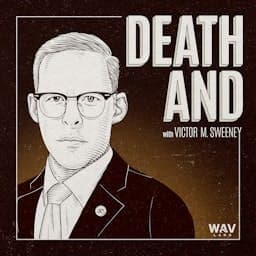



In this episode of "Death And," funeral director Victor M. Sweeney takes listeners on a solo exploration, reflecting on his own tendency toward magical thinking despite being a natural skeptic. Victor shares personal stories from the funeral home that reveal how small moments of coincidence, ritual, and whimsy can bring comfort in the face of loss. He discusses the professional ethics of mortuary work and finding beauty in the absurd and serious alike, reminding us that when it comes to death, logic and mystery often exist side by side.
http://deathandpodcast.com
http://youtube.com/@victormsweeney
http://instagram.com/victor.m.sweeney
http://tiktok.com/@victormsweeney
http://x.com/victormsweeney
http://simonandschuster.com/books/Now-Departing/Victor-M-Sweeney/9781668062111
Learn more about your ad choices. Visit podcastchoices.com/adchoices
[00:00:00] Sehr gut, sehr gut, sehr gut. Sehr gut? Wieso Steuer ist sehr gut? Das sagen ganz viele. Cool, wer sagt das? Stiftung Warentest, Computerbild, Focus Money, Chip, Finanztipp, such dir was aus. Mega, aber das ist doch bestimmt kompliziert. Nö, einfach Foto von der Lohnsteuerbescheinigung machen und fertig. Klingt sehr gut. Ist sehr gut. Hol dir dein Geld zurück mit Wieso Steuer. Was deine Haut braucht, ist was deine Haut braucht.
[00:00:26] Pigmentflecken reduzieren und vorbeugen durch innovative Wirkstoffe und höchsten UV-Schutz. Eubos Anti-Age, dein neues Duo gegen Pigmentflecken und Hautalterung. Eubos, Individual Skincare. You could say that that was just a fluke, Victor. Or maybe some of that magical thinking works.
[00:01:01] Death and magical thinking. Hello everyone, I'm Victor M. Sweeney, coming to you live from the funeral home. I want to thank you all for being here, especially as I give a monologue, which I find is equal parts challenging and surprisingly easy once I get going. Today's topic is something that I really enjoy because, to be honest, I am a magical thinker at heart.
[00:01:29] Now, before we get into the crux of it, I want to get to some questions. There were some good ones that came in and they deserve our attention. If you go through the trouble of reaching out to the show by email at deathandpodcast at gmail.com or heading to deathandpodcast.com, I want to reward you for the trouble and try to answer your question as best I can.
[00:01:57] Okay, here's a question from Marianne. I wanted to know how you deal with burn victims, especially severe cases. Can you have an open casket? Can you embalm when they have deep tissue or vascular damage? Have you ever refused any that are extreme? So, I'll tell you what. Burns are one of the things we really struggle with. There's not a great way to restore someone who has severe, severe burns.
[00:02:26] Some burns, yes, if you can excise tissue, sculpt over it, that sort of thing. But if we're talking someone who died in a fiery car wreck, or I had a gentleman who was an older guy starting a fire in his field, fainted, fell into the fire. Okay, the thing is with something like that, or a house fire, there's not a lot we can do.
[00:02:50] Because at the end of the day, if the fire has done what it naturally accomplishes, the tissue will no longer be there. You will end up with skeletal charred remains. So, to that end, if the family has a body present, it will be in a closed casket. But often, though, one of the other terrible ends of this discussion with a family is,
[00:03:16] do you want to complete what the fire started and have cremation? And that is an extremely difficult conversation to have. Because on one hand, the fire is what has caused the death. And you don't, at least my inclination is not to give it any more than it has already taken. But on the same token, so much of it has already been done. Maybe get the thing over with. It's hard. It's tough.
[00:03:46] There's not a good way when dealing with severe burns or severe fire. It just, it's just awful. So, yes, I've, there's not much we can do. We've had to tell families these two terrible options of either the closed casket or let the fire continue its work.
[00:04:36] Here's a question. This is a good one. From Sam Ashby. Okay. I have a more practical question about funeral services. I was wondering if funeral directors were bound to something similar to HIPAA. It's very interesting to see the differences and similarities between healthcare and mortuary services. Yeah, there is a strange overlap, isn't there? I remember when I was doing my orientation at my mortuary school at the University of Minnesota, which is the only one in the country attached to a medical school.
[00:05:06] The mortuary students are off doing their own thing with all the potential medical school students. And the parents are all doing whatever parents do during orientation at the medical school. And they're going around in a group. They broke into small groups, I guess. And they're going around in the group. And the parents are saying, you know, my son's pre-med, pre-med, dental, pre-med, pre-med. And it gets to my dad and he kind of smirks and goes, post-med.
[00:05:32] And people didn't know what to make of that because there are not that many morticians in medical school when it comes down to it. But to your question, one of the more eminent lawyers in the country, the funeral lawyers, has made it very clear to us in Minnesota that funeral directors, morticians, do not fall under HIPAA. So in some ways, we are bound strictly by our own consciences and our own code of professional conduct.
[00:06:02] But it's actually kind of nice in some ways that we are not bound by HIPAA because then if we need to know how someone died, we can find out. We don't have to wait for the next of kin to authorize the hospital to tell us what's going on. We can learn what the cause of death was or if they have a communicable disease. Now, does this lead to problems with morticians oversharing? I ask pointedly in my own case.
[00:06:32] Yeah, here's the thing. You have to be extremely careful. Oftentimes when I share stories, I will change details. I will swap genders. Even in the writing of my book, Now Departing, which I will shamelessly plug here, I wrote everything out from my book. And then I actually sent every person I discussed a copy of the chapter in which they appeared and asked them whether they wanted to use their name or their loved one's name.
[00:07:01] Or, you know, have me change the details to make it more anonymous. Because it is a very sensitive topic for some—I mean, I know the reason. But for some reason, we could say. Especially when we're dealing with death and the kind of nakedness of the deceased, both physically and metaphorically. They're not there to clear their name or maybe hide unsavory details.
[00:07:29] When we're dealing with that, we have to be extremely, extremely careful. So while we don't fall under HIPAA, I like to think my own code of conduct more than covers that dimension. Thank you for the question. Thank you for the questions, everyone. I really appreciate them. I say it all the time, and I know maybe it sounds saccharine and redundant. But it's true.
[00:07:58] I really appreciate you reaching out. Because in some ways, even on a monologue show where I'm just blabbing to the universe, the show is ours. It doesn't belong to just me. It belongs to everyone that crosses its path. Whether you send in the question, which I love. Or you're listening. So thank you for doing it, everyone. To the topic today, I wanted to talk about magical thinking.
[00:08:24] Because I realized the other day that I am both a natural skeptic, but also a magical thinker. And I don't quite know how to square it. For those of you that don't know, magical thinking is, well, it's exactly as the name implies. It's the idea that the things we do have knock-on effects that we do not understand, that are mystical in their nature.
[00:08:55] And usually it's implied that they don't always make sense. There's something borderline compulsive about being a magical thinker. For instance, every time I get something new that I really like, my magical thinking part of my brain is always very worried that I'm going to lose something else that I like. It's a trade. You know, you get a new pair of, I bought a new pair of overalls recently that I really like.
[00:09:24] And I'm like, oh no, now I'm going to rip out the knee of my second favorite pair of pants. You know, because there can only be X number of leg coverings in my house. And that's not true, is it? It's not really factual. But in some ways I think it's okay because then it somewhat limits me on how many leg coverings I get, whether they are overalls or pants or shorts. I don't know. Or maybe it's nonsense. Maybe it means nothing.
[00:09:53] But then when it happens, when I inevitably blow out the knee of my second favorite pair of pants next week, I'm going to go, that's because I bought those overalls. But I think in some ways you can't help but be a little bit of a magical thinker if you are in the death industry. Because we are surrounded with so much mystery. And while I might also be a bit of a natural skeptic,
[00:10:19] I hear something like, well, when my dad died, a butterfly flew past the window. And I think, well, yeah, of course, it's July and the butterflies are all over then. It'd be a real magical thing if it was in deep, dark December and a butterfly flew past your window. Of course they're out in July. Of course. But then something else happens in the natural world and I start to wonder if maybe the magical thinking isn't the truer part.
[00:10:48] I was out in the cemetery just last week. And we had a burial of an urn. And as it so happened, the gal had passed away on the coast. I live deep in the middle of the United States. So she passed away. We had her funeral scheduled some weeks out. And the funeral home on the sending end really honestly dropped the ball. There's corporate funeral service for you.
[00:11:17] And they ship her out quite later than I expected. She's supposed to arrive the day of the funeral. And she does not. So I'm getting ready for the funeral. I'm tracking these cremated remains being shipped across the country by the postal service. Refreshing it every 10 minutes, hoping to see an ETA or something.
[00:11:41] And she ends up landing in the postal service package center in a town two hours away. And so I call one of my friends at 9 in the morning. And on a Saturday, I tell him, hey, I have a package I need driven up to me two hours. Right now, can you help? And so he gets the package and he hauls it up here. I think his foot was on the floor the whole time.
[00:12:09] Didn't make the funeral, but we did make the burial. So we have this tumultuous event, getting mom home for burial. We get out to the cemetery. And in the interim between the funeral and the burial that we had to wait for our gal to arrive, it starts to rain and it's gray and it's dark. So we drive through the rain to the cemetery. And we're standing around the grave.
[00:12:35] And the son places mom, but not the picture of mom that we had at the service, but the urn. And he places it on the urn wreath by the grave. And all of a sudden, the rain stops. And the sun comes out, literally shining down where we are standing in the cemetery. And the priest says his prayers. The family places her in the urn vault.
[00:13:05] And we lower her into the earth. And the rain starts again. So while I could say part of me wants to believe, ah, that's just weather. Part of me also thinks it's something more. Part of me thinks it happened because we had the tumult. Because we had the drive in the early morning to bring her. And I think that's okay to believe in both. I really do. Because these sorts of mysteries happen all the time.
[00:13:33] There's a piece of magical thinking that I thought of the other day. I had one of my old lady friends pass away. And brought her to the crematory at 2 a.m. And as I'm getting her boxed up, I go to put the coin in the casket. When you're cremated, you receive a coin with a number on it.
[00:13:59] And that disc, that coin, stays in the casket with your remains. So that's how you track the remains when someone's rendered to only skeleton. Right? You can't tell who it is in there, but you have the disc and the numbers you can track. And so I had a coin. And I was very tempted. I thought, what if I put this coin in her mouth?
[00:14:23] You know the Greek myth of the river man over sticks, Charon. And you give him a coin. Right? So you can pass over the river. And the dead then were buried with a coin in their mouth or on their eyes as a sort of grave good.
[00:14:45] And I thought, what if the coin in the mouth speeds up the cremation in some way we do not see? What if it assists her on her journey? Talking to one of my friends, he said, what if you put the coin in her mouth? And she wakes up in the Elysian fields with the Greeks who haven't had anybody come to them in a thousand years. And they're wondering what the heck is going on. It turns out it works.
[00:15:15] And I thought deeply about that and pondered that idea. I did not put the coin in her mouth. I placed it on her chest. But the idea really tickled my brain. I could almost write a short story about the first person to come to Elysium with the coin for the ferryman. And a thousand years because some silly undertaker put a coin in their mouth when they died. And I don't know if that changes anything about what happened. I'm sure it didn't.
[00:15:44] If I did it, I don't think it would. But the kind of beautiful ancient poetry it makes you think of. Of how many bodies went to the earth with the coin on their tongue. That was probably one of the first things to decay. Or over the eyes. And soon the coin was just resting in the cavity between the upper and lower jaw. With no flesh to hold it in.
[00:16:14] Kind of magic. Kind of beautiful in its strange, macabre way. Don't you think? And the thing is, the idea of the coin being a grave good is still around today. Not in the mouths of the deceased so much. But go to a veteran's cemetery sometime. If there's one near you, I would encourage it. One, I think they're quite solemn and beautiful. And I like the uniformity of it. But go to a veteran's cemetery and you'll see.
[00:16:44] You'll see dimes and nickels. Pennies sitting on top of the headstone. And there's all sorts of symbolism that people say it does or does not mean. But it's the token that someone visited. It's the token that someone was there. They were thinking of you. Saying hello. Saying a prayer for you. And not that they gave you the token to cross the river Styx. But the fact that it's still there, it's a coin.
[00:17:15] Sometimes we see it, the Jewish ritual, they use a stone. But the elements of it are all there. The token that you're doing with Shopify. And knock Umsatz-Recorde with the Checkout with the world's best conversion. You heard it right. The Checkout with the world's best conversion. The legendary Checkout of Shopify. It's just a shop on your website. It's just a social media.
[00:17:44] And everywhere. And everywhere. And there's music for your own. Like you do it also do and do it. With Shopify. You can do a real hit. Start your test today. I have another story for you. This isn't related to coins. But to some other bit of magical thinking. Have you ever heard of the idea of witching for water?
[00:18:14] It's where you take two rods. Sometimes they call it dousing. You take two rods. And you walk. And you hold them apart. And where they cross, that's where water is. Allegedly underground. Now I'll admit this is a pseudoscience. Okay? It's right up there with phrenology. But there was a time some years ago. I was burying a... She was older at that point. But burying a mother. And she had a baby die back in the 1980s.
[00:18:44] And it was her plan in her wishes that when she died, she wanted her baby disinterred from the baby section of the cemetery. And put with her and her husband. Which is a common request. This is something we will do when my parents die. I have a sister married who was born before me. So the mom passes away. And I am in charge of disinterring the baby. Now interestingly, in my state, you don't need a disposition permit to disinter a casket and move it within the same cemetery.
[00:19:13] So I didn't have to do any legal paperwork. But I still had all the family sign off. Let them know too that it can be, well, sometimes you dig down and you find nothing. That the tiny baby bones have all but dissolved. And in those cases, you dig up about as much dirt as you can and you move it over to the new grave. In this case, I looked in our records and we had what's called a combo unit.
[00:19:38] So it's a small baby casket that also has a hard plastic shell. Typically there's a piece of putty between the lid to prevent some elements of water encroachment. And so if I put a rod down into the grave, I should be able to find it. Now here's the thing. Baby Tiffany's grave was never marked from the 80s.
[00:20:07] So it's in baby land. I know about where it is. I have the lot description. There's no marker. So it's an afternoon. I'm in my grubby clothes and I start digging. And this grave, the baby graves are only three feet by four feet. So it's a very small area. So I start digging and digging and digging and digging and digging. And I get three, four feet down in a three by four foot area. I've been digging for quite some time and there is nothing. Not at the head end.
[00:20:36] Not at the foot. And so I sit back and go, where is she? So my magical thinking comes into play. I grab my rod that I used for sounding to see if I could find the grave. I grab the handle of my shovel and I think, you know, I'm going to walk with these two parallel. And if they cross, maybe that'll tell me something. So I walk back and forth across the grave. Nothing.
[00:21:06] I go a little further to the north. Nothing. The south, the same. I go one row to the west and start walking. I pass the hole that I've dug. I go further north and they cross. Now I know this is bunk. Right? This isn't real. You can't witch for water. You certainly can't witch for a grave. I put my shovel in the ground and I hit something hard.
[00:21:35] Now here are some clues. All around baby Tiffany's grave, going three directions, well, three graves to the north and three graves to the south, and graves on either side are all boys. Further, they're all older graves. So they're not combo units, rather. They're wooden baby caskets. So I've hit something incredibly hard.
[00:22:00] So I dig off the top six inches of dirt and I find the top of a combo unit. And in, you know, scraping off the top, the lid kind of opens itself up and it's full of fetid water. The smell is terrible. But I figure I'm this far. Let's have a peek.
[00:22:22] And in that combo unit, in that baby casket, there is a mostly intact body of a baby. Further, it has flesh, or it appears to be fresh. It could be what's called grave wax.
[00:22:44] The only thing missing are a couple of the fingers, a couple of the toes, and the top of the skull. But it is identifiably a female. It's the only female. It's the only female for yards in any direction. I call the sister, the living sister. And I say, hey, I found baby Tiffany.
[00:23:12] And she goes, the weirdest thing is that she's mostly intact. I thought we would get just bones. And she says, can I see her? And I say, no, she's missing the top of her head. And you know what the sister says to me? She goes, well, then you know for sure you've got her. Because she was born without parietal bones. She was born without the two bones on the top.
[00:23:41] That's why she died. But that's why everything else is there. Okay? And so to conclude the story, we disinterred her. There was a little ankle tag with her name. So we had it right. We put her in a new combo unit. We buried her with mom. Now, you could say that that was just a fluke, Victor. You could have stomped around in the cemetery and probably found that anyway because everything else was not one of those combo units.
[00:24:11] Or maybe they got the lot description wrong. They gave you the wrong place. She was buried in winter. Maybe they just dug in the wrong spot. Maybe. Or maybe some of that magical thinking works. If I was a purely prosaic person, I would have given up. Well, she's not in this three-by-four-foot area. Tough luck. And if I was that prosaic, it probably wouldn't matter to me, would it?
[00:24:39] If a baby is reunited with its mother 50 years after the fact, it matters. It matters. It matters because of the magical thinking. Is not the reuniting of a baby with its mother beautiful? Isn't it full circle? To have to be taken from your mother, both physically and by death.
[00:25:08] But then brought back with her again. In death. It colors what I do. The magical thinking is all right with me. Now, I have some more silly kind of magical ideas in store for the funeral home. Probably not going to change much in this room. This is a... I mean, it's a room of business, isn't it? But one thing I've been thinking about to kind of add a sort of levity to the place is...
[00:25:36] I don't know if you've been in a dentist's office recently. Especially if you have kids. They go to the dentist and they give the kid a treat, a toy, a slinky, a bracelet, a bouncy ball. And there's a little chest, right? A little bin of trinkets that you get. And I thought, what if I had a treasure chest at the funeral home? Not something on the nose like a casket, God forbid, no.
[00:26:07] But a toy box where if there was a little kid that came to a visitation, I could say, hey, pick a Hot Wheels car. Go play. Go drive it on the pattern of my carpet. Right? Let your parents grieve a little bit and give you some space, but also something to do. Or maybe I get a part of that treasure chest that I have. I have some candy. I like coloring books and that sort of thing here at the funeral home for kids.
[00:26:34] But I think to choose a little trinket at a challenging time would bring some comfort. Maybe I get a bunch of tiny little stuffed animals. You know, something one could hug even if it's just in two hands. A beanie baby. Here we go. That's how you get rid of all the beanie babies that were collected in the 90s. You give them to funeral homes to give away the children. I don't know.
[00:26:58] But there's something about the whimsy of it and contrasting that with the challenge of death. Is there not? That we do the hard thing, but also we can do the silly thing, I think, at the same time. That you see the gravity of the situation. But then you also see the absurdity. Maybe the beauty. Maybe both.
[00:27:26] Of saying, oh yes, dad's spirit is now a butterfly. Or when you find a penny on the ground, you say, oh, that's my auntie thinking of me. It's absurd, but it's comforting. And just because maybe it's not factual doesn't mean it's not true. My favorite writer, Chesterton, he talked at length about, he wrote a lot about dragons and about Santa Claus.
[00:27:53] And that they are, in essence, the same thing. Right? Just because Santa Claus isn't factual doesn't mean he's not real. It is the embodiment of charity and love and unconditionality. Right? And those things are real. They don't have to be 250 pounds in a red suit. But they're real.
[00:28:20] And I sometimes think that a lot of the magical thinking turns out to be real as well, on a deeper level. Factual or not, it is real. And these are the flights of fancy that I think color my work and make the day-to-day worth doing. Because you can see the value. You know, does my time for two hours in the middle of the night, fixing proteins by embalming, is that what matters?
[00:28:50] Is it the fixing of the proteins? Is it the disfiguring of them so enzymes don't break them down? That doesn't matter. It only matters in as much as the family sees the dead and they connect that to their living memory. That's real. The facts are less important. The reality is what drives it home. I want to thank you today for listening to me ramble about magical thinking.
[00:29:20] If you are a magical thinker, just leave me a comment. Tell me the stupid little magical thing you believe in. I have to tell you, I'll probably love it. I'll probably agree with it. And I'll probably find that it's not stupid. It's both. And. It's both insignificant and extremely significant. It's both silly and also something that changes the way we think. When death comes knocking, we can't but help to see both sides of things.
[00:29:50] The beauty and the ugliness. The physicality and the spirituality. The serious and the absurd. Death brings these two things together over what I like to call the narrow chasm. There's a distance between them. And it's very deep. Short. And you can somehow bridge the gap and reach both. At the same time. I'm Victor M. Sweeney. Thank you for joining me here in the funeral home
[00:30:19] for this episode of Death and Keep Magical Thinking. And I will too.