
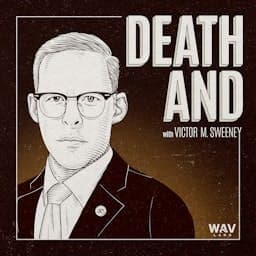



In this episode of "Death And," mortician and funeral director Victor M. Sweeney reflects on how families and friends can play a meaningful role in funerals and grief work. He tells poignant tales of families who found healing and meaning by participating in the physical acts surrounding a loved one’s death—like helping with transport or carrying the urn—emphasizing that these tangible gestures create lasting memories and foster deep connections. He invites listeners to ask for ways to be involved themselves, encouraging everyone to see grief work as both a grounding and transformative process.
http://deathandpodcast.com
http://youtube.com/@victormsweeney
http://instagram.com/victor.m.sweeney
http://tiktok.com/@victormsweeney
http://x.com/victormsweeney
http://simonandschuster.com/books/Now-Departing/Victor-M-Sweeney/9781668062111
Learn more about your ad choices. Visit podcastchoices.com/adchoices
[00:00:00] I told the family when we were meeting in the interval between when she passed and when the flight would get in. I'll be there to meet the plane, I'll check her in, we'll bring her home. And the sons look at me and they said, can we bring mom home? Death and Getting Involved
[00:00:30] Hello everyone, I'm Victor M. Sweeney, your host of the Death And podcast. I'm here today to talk about getting involved in funeral service and not becoming a mortician or something like that, but simply being someone who attends a service, or maybe you have a loved one die. How is it that you can get involved?
[00:00:53] I have some stories along the way that I'll share with you because that is honestly, I think, part and parcel of what makes anything I do here worth it. There are lots of folks on the web these days. That was an actual cough. Lots of folks on the web these days purporting to be morticians, or maybe they have their license, or maybe they once had their license, but they're not typically working full-time in the industry.
[00:01:20] They are working full-time to get clicks, and I am still trying to hack out a living in the funeral world. Anyway, because of that, I have lots of stories, lots of examples, and some hard-won experience along the way. Maybe that's why you're here. But a lot of you, too, have your own experiences, and that's part of the beauty of the show is we can rope you in. You can include your experience in the form of a question.
[00:01:49] We're going to answer some questions. Don't worry, we always do. But for those of you that do have a question, maybe one that's been on your mind, on your heart, wiggling in the back of your mind as you sleep, if you have a question, you can go to deathandpodcast at gmail.com, or go to deathandpodcast.com, where you can leave a voice memo. That's always pretty fun. If you're feeling extra helpful, extra generous,
[00:02:19] you can buy me a cup of coffee, air quotes, on Cameo, and shoot me a couple bucks, and I'll answer your question that way. I am not always dressed in a suit. I might be sitting on my porch having a cup of coffee, but I can answer your question there, too. Let's see what we've got in the grab bag today. Here's a question from the friend of a show, Ryan Swift.
[00:02:47] He sent me an email, and I told him I would answer this one. Do you have other people at your funeral home that you can call upon for particularly difficult removals? For example, if you had a 150-kilogram, around 330-pound deceased person, on the second floor of a property with narrow stairs, who would you call? Wonderful question. So this is the interesting thing. Where I live and work, I am one of two undertakers. That's it.
[00:03:17] We have a couple helpers for funerals when maybe we're going two different directions in a day, but they are 80-year-olds, not inclined to do heavy lifting. Now, I do have a couple friends who've helped me when I'm in a pinch, but for the most part, we rely on the local sheriff's office. So if there's someone found dead at home, which would be the case if someone was very heavy up on the second story, right? The sheriffs will be there. They'll help us.
[00:03:45] Let's say someone is rather heavy and they've died at home on hospice. That will almost always be on the first floor. But there might be steps out of the house. And if that's the case, usually I'll ask if there's family present and we'll all work together. It's something two people can easily navigate, typically. For situations with stairs and narrow hallways, really nice to have the sheriffs. And if there's nobody there, I've got my friend Chris, who's a lawyer in town. I've called him to help before. Another buddy, Tom, who's a farmer.
[00:04:15] He's helped me. I once had a body that was shipped back from somewhere down south. And they had a copper casket. So the gentleman was already big. He's in a solid copper casket. It was a heck of a thing. Went to the airport. Picked up the human remains, the HR, from the cargo bay at about midnight. Got back at 2 a.m. And just could not muscle that out of the van myself.
[00:04:42] So Tom came over to help me in the wee hours of the morning. God bless him. So yeah, there are a couple people I can call. But for the most part, I go to places of death by myself. And that has actually led to some really lovely experiences of actually illustrating the point I want to illustrate in this episode today. Of inviting people in to actually help me. So having them shroud the body. Having them help me lift the body. Move the cot out of the house. Things like that can actually be rather meaningful.
[00:05:12] So it's, and sometimes I'm grateful I don't have a lot of extra jumpsuited help. You know what I mean? Thanks for the question, Ryan. Ooh, here's a great question. This is from Father Mason Lumpkins. As a committed Catholic yourself, do the teachings of, I should say, our faith influence your decision on how you market your merchandise? For example, does it cause you to pause to recommend any of the many products that separate
[00:05:41] cremains, cremated remains? For example, jewelry or mini urns to share with family or friends. Ooh, Father. Good question. Yes, my faith does influence me a lot in the profession. But I've spent a lot of time thinking about this because I really, as far as faith goes, I don't believe in the separating of cremated remains. I think the body needs to remain intact. It's part, it's the integral part of what makes us human, right?
[00:06:10] If we were only souls and the body didn't matter, we would be angels. And if we were only bodies with no souls, we would be objects. So we're right in the middle in that tension, right? Between body and soul. And when we die, they break apart. But both halves are still incredibly important. So typically what I will do is I will tell the families a story, the families that are choosing to separate remains. I'll give them a warning based on my own experience. And it is this.
[00:06:38] When my grandpa, a non-believer, Methodist, I don't really know where he sat. Anyway, my grandpa Bolton, when he died, my grandma called me up and she's like, hey, honey, I'm going to, one, I'm going to keep his urn at home until I die. And two, I had a piece of his remains made into this beautiful little paperweight. See, it's so beautiful. And it is. It was a beautiful piece of glass with his bone fragments floating around in there. It was very pretty.
[00:07:08] But the fact is, what happens if we in the family forgot that grandma made him into a paperweight, right? Does that, when she dies, does that migrate from her desk to the trash? Does it get picked up and brought to Goodwill and sold at a thrift store for a dollar? Like my grandpa's bones are worth a lot more to me than a dollar.
[00:07:33] So the thing about it is that there is this practical element of what do you do, right? Do you, if you have a keepsake urn of grandpa, so you have it and you give it to your kid, who then gives it to their kid, who gives it to their kid, who gives it to their kid. And by the time you've accumulated 36 miniature remains of their ancestors, none of which they know, none of which are identifiable in any particular way because human pulverized bone dust is human pulverized bone dust.
[00:08:02] So then what do you do? You pass it along and you let the fourth generation down, figure out what to do with your stuff, which is actually something really important. So I don't really encourage that. I think as far as really customized keepsakes go, I like fingerprint jewelry quite a bit. Um, and we offer that too. We of course offer, you know, the standard, uh, cremation necklace with a little niche to put a tiny little fragment of bone dust in.
[00:08:30] But, uh, I don't like that these things can get mislaid or get forgotten about, or people can misunderstand the extreme value they have, or they, they get passed down to someone who doesn't recognize their value. And then they have the burden of what to do with them. So I'm not a big fan of it, uh, just on a practical level. And then on a, on a faith religion level, I just don't, I just don't believe in it. There you go.
[00:09:11] Thank you everyone for the wonderful questions. It always is such a pleasure to see what you folks have in mind. I, I don't really, I don't read the questions beforehand. I, I have some friends who helped me put the podcast together. Uh, Adam, shout out to Adam. He selects them for me and, uh, and I'm just winging it. So I'm sorry if my answers are sometimes disjointed. Sometimes I find they come out very well. Uh, and that is all just luck of the draw.
[00:09:40] If you want your question answered by a professional mortician, I don't just play this on the YouTube. I do it in real life. You're liable to get an answer, probably an example. Shoot me a question. I'd love to hear from you and, uh, just know how grateful I am to all you listeners who have sent them in already. And now to the topic, death and getting involved.
[00:10:03] So, again, we are going to be talking about how does one get involved as someone maybe planning a service for their own loved one. Uh, because really there is something about what we call grief work. Uh, we've talked about it on the show with various guests, but grief work is really important. Uh, the idea that, that the physical things we do have meaning. They have, they have spiritual ramifications.
[00:10:32] The physical things we do. In the Catholic world, we'd say it has a certain, uh, sacramentality. But there is, there is this, this tangible physical action that changes us internally. And, and now you might think that's a bunch of, bunch of, I don't know, harem, scarum nonsense. Okay. Um, but I've seen this across the board from the religious to the, the decidedly non-religious.
[00:10:57] That the physical act of, let's say, being in the same room as a bunch of people who feel sad in the same way you do is a healing thing. Uh, I once had a family. Uh, we were planning for their mother who died, uh, in the Carolinas. Not one of them. I can't remember which. And, uh, that's what we call in the funeral world a trade call. Okay.
[00:11:22] So every so often we'll have somebody from my town die somewhere far away, or maybe someone from far away die in my town. And when funeral home works with another funeral home, we call it a trade call. So we, we do work for another funeral home at a very discounted price, uh, because we know someone on the receiving end, on the home end, will be doing most of the work. We're just doing the front end. So we had a trade call to get Rosemary home.
[00:11:50] And, uh, the funeral home in whichever of the Carolinas, they embalmed her. They put her in what's called a shipping tray. So that's a, uh, wood-bottomed tray, I guess, with a cardboard cover. And on that cardboard cover is listed flight details, who it is, this and that, way bill numbers, all this stuff. They brought her to the airport and they flew her home.
[00:12:14] Now, typically I will go meet the plane when it arrives in Fargo, North Dakota, which is the, the nearest airport that takes human remains. And that flight almost inevitably comes in at 11.55 PM. And so I told the family when we were meeting in the interval between when she passed and when the flight would get in, I said, well, you guys, uh, part of the deal. I'll be there to meet the plane. I'll drive down there. I'll see it at midnight.
[00:12:43] I'll check her in. We'll bring her home. And the sons look at me and they said, can we bring mom home? And I stopped at as well. I've never had anybody ask to pick up their loved one's body from the airport, but there's no reason you can't. Uh, so what I did is I made them a map of where you go to the airport, where the, the cargo is, is received.
[00:13:10] Uh, I got them the, uh, disposition permit and transfer paperwork. I got them the airway bills. I gave them a number that you're supposed to call, you know, before you arrive. So they know you're coming. And, uh, I said, here's the deal. Um, in my state, whenever we transport a body, it has to be in a covered, uh, vehicle. So you're probably picturing a hearse. Um, but this could be the back of a pickup truck. So long as it has a topper.
[00:13:39] Uh, and they said, well, we can get a trailer. So they called up their friend and they said, Hey, we need to borrow your snowmobile trailer. And their friends are like, yeah, sure. Whatever. They didn't tell him what it was for by the way, which I thought was a hilarious move. And, uh, and they're like, all right, so we're going to go stop at the bar. Then we're going to pick up my, or they're going to go pick up mom and go stop at the bar on the way home. And I said, well, you can't do that.
[00:14:08] You can stop on the bar on the way there if you wish. So they did. They, uh, they hooked up the trailer to their truck. They stopped at one of the bars on the way. All six kids, I think, uh, had a cocktail. They went to pick up mom at the airport at midnight. And, uh, at two o'clock in the morning, I get a call, Victor, we're here. So I go to the funeral home and it's dark. There's one street lamp and there's a big trailer in the driveway of the funeral home.
[00:14:38] And so I parked my car. I opened the garage door. I get a casket truck, little wheelie cart that scissors open and closed. And I go around to where the trailer is and the siblings are all sitting on a couch in the back of the trailer with mom's casket at their feet. There was some nonchalant, hey, Victor, mom's home. So the boys each pick up the sides.
[00:15:07] We lift her on to the wheelie cart and I get her inside and, uh, shake their hands. And they ask, can we just sit here for a little while longer? Sure. You're not bothering me. So I closed the door and went home for the night. Uh, but as strange and wonderful as that is, and as, uh, disgruntled as their friend was to find out that his trailer was used to haul their dead mom home from the airport at midnight. They still talk about that with me.
[00:15:36] That family still will, will kind of smile. Say, Victor, remember when we did a crazy thing? But the thing about it is it's not crazy. That is the, the definition of grief work. They, they did something for their mom that, that normally we, we off-source to someone like me. They did something for their mom. They, they brought her home one last time.
[00:16:03] And in some ways there, it mirrors this because how many times did she get driven down to the airport and fly off to the East coast to be with their other sibling? And now they're doing the same thing, but in reverse, they're bringing her home again, which I thought was really beautiful. There's a poetry in that.
[00:16:25] And not every family is going to be willing to wake up and drive to the airport and go to a part of it they've never been before at midnight with a trailer and get a bunch of side eye from the guy driving the forklift who brings the, uh, the human, the body out. But it's really beautiful. And I think it's a gift. And that's probably at the heart of what the grief work is, what getting involved actually is. It's a gift that you give to the deceased.
[00:16:52] I've talked about this before when we had Patrick Lynch on the podcast, but this idea of mitzvah, this, this Jewish idea of an act of charity that cannot be repaid. So mom cannot drive them home from the airport, but they can do it for mom again. She cannot repay them. And it's that act of perfect final charity that I think is really beautiful. Yes, they've conveyed her hither and now thither.
[00:17:22] The physicality of it is good. The physicality of it is important, but there's this deeper underlying. Spiritual aspect. That we did something. And that's, that's really at the heart of, of what I try to do for families all the time. There is, there is really something important about getting families actually involved, right? Not just sitting passively in the pews.
[00:17:52] And, and something I've found over the years that works really well is I'll come up. A lot of times I just wing it. But I'll come up with something on the fly that I would like a family member to do. An action I would like to occur. And I almost give no preface to this. It just happened to me yesterday. I had a funeral, a little cremation service at a beautiful little country church. Urn was up front.
[00:18:22] And at the end I had the family stand up to process out. And I looked at the brother and I said, you're going to carry your brother out. And handed him the urn. And I looked at the, the surviving sister and I said, you're going to carry his flag. And I handed her the flag. And so they processed out behind me. One bearing the flag. One bearing the bones of their brother. And you wouldn't think it's a big deal.
[00:18:51] Carrying a small box and a piece of folded cotton out to a graveside. Where there are two men in dress military uniforms waiting. But it turns out it is important. It turns out that it's not just the movement. It's the gravity of the situation. Whereas you might make it through a funeral. Well composed. Sad.
[00:19:20] Grieving. Yes. Not crying. But it's almost universal. When I hand over the urn. When I hand over the flag. When, when they hand off the flag to the man who's standing at attention. That the tears flow. And that's how you know the grief work is good. There's one aspect of grief work that I think is overlooked.
[00:19:48] And I think it's because it doesn't seem physical. Okay. And this is probably not a very hot take. You know, maybe it's a hot take. But not a very popular one these days. But it's this. I would say that seeing the body is grief work. Because it is a physical thing. Right? And I have some examples of this too.
[00:20:16] One from my own life that I, maybe I find the loss of it more acutely. Because I'm a funeral director. And this is what I believe. I think everybody felt the loss very seriously. But it's when my friend Alex died. And I won't go into all the details here. But my best friend died in 2018. And I think about him every day. I bring him up all the time to my family.
[00:20:43] And at any rate, the manner of his death was not pretty. And as such, we could not see his body. And he was brought home. It was a trade call from another state. He was driven back because it wasn't quite as far as a flight, I think. But he was brought home. And the funeral director in the town where he had his services put him in the casket. Dressed him. Put him in the casket. But we didn't get to see him again.
[00:21:13] And at his funeral, I was a mess. Cried the whole time. Except when I stiffened myself up enough to give the eulogy. And then immediately began crying again. And I was blessed. I got to do some grief work. I got to speak about my friend. And I got to be one of his casket bearers. I cried the whole time when I carried him out. And you could feel him in the casket. You could feel him. You could feel his weight. His solidity.
[00:21:44] In a box with handles. So that was grief work. But I didn't get to see him. And I'm on the inside. I know what a body looks like when the manner of death has been hanging. I know what that looks like. It's not pretty. And I don't know if I would have wanted to see my friend like that.
[00:22:13] I can picture it in my imagination. But I do think that the physical act of seeing his body again. In a proper state. In a way closer to what I remember. Would have provided to me some measure of healing. It's been years. I still think about it. I still think about the closed box. With the yellow roses on top.
[00:22:46] And I know why we didn't open it. But if I would have been able to see him with my own eyes. Maybe I wouldn't get quite so spooked when I see somebody that looks like him. That has the same silhouette. But he always used to joke. A la Andy Kaufman. About coming back. In 25 years. I might even just throw a party for him. In 25 years from his death. Might just do it.
[00:23:15] See if he shows up. But I would have liked to have seen him. And I've seen this play out again and again. Not just in my own life. I have one particular experience that haunts me a little bit. Because I can hear it. That was my grief work was to hear. But the story goes like this. I had a gentleman fall. From a building.
[00:23:46] Head first. Barely survived the fall. They rushed him to the hospital. And they removed part of his skull. In surgery. After several days. He didn't make it. He died. And when I was on the phone with the family. That evening. The daughters said. We know it's going to be closed casket.
[00:24:15] It's too bad. We've been here in the hospital with him. We didn't even let the grandkids see him. He looks so bad. So I get him back. And this is a man whose company I. I deeply enjoyed. And so first. I reopened the incision. On his skull. And this seems like a cruelty. Because it had just. Been starting to knit closed. I pulled out the staples. One by one.
[00:24:44] I lacerate. The. Just barely healing laceration. There's no skull bone underneath it. A part of his. His parietal bone has been removed. To relieve pressure on the brain. They didn't include it with his body. I assume it's been incinerated. They had an autopsy done. Cranial autopsy. So even the back of his head is. Opened. So as I'm.
[00:25:14] Reassembling the. The bones of his head. Locking them into place. With a couple different devices. And sutures. There's still a great big opening. His brain has been removed. So I take a. Styrofoam head block. And I whittle it. To fill the space. To give him. A firm cranium. At least by appearance. Once again. After several hours. I'm done. He looks like himself.
[00:25:44] His hair has been cut. In the hospital. From the. Usual. Beautiful pompadour. That he usually wore. So that's unusual. But he's there. I've relieved the bruising around his eyes from surgery. I've waxed over. The lacerations that have. Healed. And then been cut open. And then sutured closed again. His skull is firm. Albeit a bit lighter. Because his. Three pound brain isn't in it. In it.
[00:26:14] I put a little wax over the incisions. And I cut some hair from the back of his head. And do a little hair restoration over the wounds. Over the cuts. Over the places where they've. Tried to fix a problem that was nigh unfixable. The day of the funeral. We're at the church. The daughters assure me. It's going to be closed. I tell them.
[00:26:44] Would you just trust me? How about just the three of you come? I want you to see your dad. You've been with him in the hospital. I promise you he's better than that. So. We open the casket. And the daughters stand around. And you can see this. This weight lifted from his shoulders. The weight drops. They all hug each other and cry.
[00:27:16] And yet something goes amiss. There's still this. This reflexive movement. To protect. The kids. To protect his grandchildren. From what? Protect them from what? From their imaginations. Run wild. Over the last week. That grandpa has fallen and had his head smashed into a million pieces. I go to the sons-in-law who are gathered in another room.
[00:27:45] The grandkids are around. I take them aside. I say, you have to talk to the girls. I think he looks great. It's got to be better than their imaginations. It's got to be better than every nightmare they've had. The grandpa's half disfigured from a fall. And yet the daughters don't relent.
[00:28:07] And as I'm closing the casket and locking it. Because it will stay closed. On the other side of the door. Which we've locked to the room we're in to view. I hear pounding. And the wails from the oldest grandson. A teenager. Screaming, I just want to see my grandpa again.
[00:28:37] Let me see him. And I can hear him being restrained by his father. Now, I don't know how I'd react if that situation was reversed. If I was in that situation. I can't really cast any judgment on it. I did try to encourage the family to just embrace the reality of it. Because yes, sure.
[00:29:04] While dad's face is a little puffier from intravenous fluid. While his hair is in a very unusual buzz cut. It's better than the imagination. The grief work of viewing. Of looking. Of having the images. Directed to our own eyes. Processed by our very physical brains. And let them become. To go from material to immaterial. What happens between our ears.
[00:29:35] Is a beautiful thing. Because I think sometimes. What happens between our ears. Can run away with us. We need that grounding in reality. I do regret. That for those grandkids. The last. Picture of their grandpa. While in life. Was vigorous. And wonderful. And coiffed. And put together. That the last image in their imaginations.
[00:30:05] Didn't get resolution. Because the physicality wasn't there. And I've been thinking a great deal. About meandering thoughts. Sometimes you call it wool gathering. These are the things that I wool gather a lot. I just sit there and think only the. Only the. The spiritual things. The metaphysical things. The things going on.
[00:30:34] Behind my eyes. And between my ears. Wool gathering. Daydreaming. You might call it. And I was trying to think. If there is an opposite. Of wool gathering. Or maybe not an opposite. Maybe something like a foil. Something that is more productive than daydreams. Which I'm prone to. And I was. I was thinking of other idioms. That deal with gathering. And I thought of this.
[00:31:05] That moss doesn't gather. On a rolling stone. And so I thought. What if. Instead of spending my time. Wool gathering. With the immaterial. I moss gathered. Right. I thought about. The metaphysical. But I also thought about the physical. And how they interact. I moss gather. I think about. How my interactions. How my. My physicality.
[00:31:35] How I speak to other people. Comfort other people. By touch. And by word. Right. All sound has physical waves. What if I think about those things. I could articulate that as moss gathering. And while moss doesn't gather. On a rolling stone. It does gather on a stone. That stays in one place.
[00:32:07] A stone that is firm. When you need it to be. That sits in a location. Waiting for people to. Discover it. When they need to. And the fact is that. Wool gathering. I mean. Wool is. A thing that was living. But was cut off. And while I won't deny. That it is. Terribly useful. Moss that's gathered. Is a living thing.
[00:32:37] It continues to grow. To change. To change. To die sometimes. But it's a living. Breathing organism. In this wonderful world of ours. And so how lovely would it be. That I. Gather moss. I stay in one place. And I bring in all the living things. Remaining solid and firm. Not transitory.
[00:33:05] In a very changing world. Maybe that's a bunch of wool gathering too. Maybe it's a paradox. For those of you that want to get involved in your loved one's funerals. I think all you have to do. Is ask. Simply ask. I know it's scary. I give you permission right now. If you find yourself in that position. Just ask. If you want to help get your loved ones dressed. Ask. If you know how to do hair.
[00:33:34] And you want to do grandma's when she passes away. Ask. If you want to go up and grab the urn. That's at the front of the funeral service. Ask. I guarantee you. Men and women in my position. Would be happy to let you do it. Would love for you to become involved. Would love for you to do grief work. To incorporate your physicality into something that I think. Becomes lost in the ether.
[00:34:03] To ground it. To bring it back down to earth. To let it be grounded like a stone. And gather moss that grows. Thank you for being here today on a monologue. I know it's always challenging to listen to me ramble on. But I appreciate you being here. You're part of the show too. I want you to do some. Some wool gathering. And do some moss gathering too.
[00:34:33] Think about the physical. The metaphysical. What your role is in all of it. Until next time. This has been an episode of Death And. I am your friend and undertaker. Victor M. Sweeney. And forever grateful that you are here. Am I out there. Wonder. Now. Thank you.