
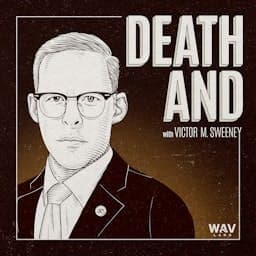


n this monologue episode of Death And, Victor M. Sweeney takes on a listener-submitted video — a bishop's directives tightening up Catholic funeral practice — and works through it clip by clip, weighing each ruling against his own years as a funeral director. He traces the faith's three-part rhythm of vigil, mass, and burial, explaining why folding a eulogy or a pre-mass visitation into that sequence breaks its motion from looking backward to looking forward, and why the church insists cremated remains stay whole and be interred within 30 days rather than scattered into keepsakes. Along the way he takes up harder questions too: whether a "celebration of life" leaves room enough for grief, and how he serves families whose beliefs don't match his own, arriving at the same conviction each time — that a good funeral, Catholic or secular, has to hold tears and laughter, mourning and hope, in the same hand.
http://deathandpodcast.com
http://youtube.com/@victormsweeney
http://instagram.com/victor.m.sweeney
http://tiktok.com/@victormsweeney
http://x.com/victormsweeney
http://simonandschuster.com/books/Now-Departing/Victor-M-Sweeney/9781668062111
Learn more about your ad choices. Visit podcastchoices.com/adchoices
[00:00:00] Imagine going to a funeral that was only doom and gloom, black and dark, and a corpse up front that was actively decomposing. Imagine that. Is that going to give you what you might need? Death and Funeral Controversy
[00:00:29] I'm Victor M. Sweeney, licensed mortician, and today I have got a very non-traditional episode for you. I had a listener send in a video that they wanted my reaction to, and after thinking on it for a little while, I decided, hey, we can make this work. Bishop Paprocki of Springfield, Illinois, recently released revisions on the practice of funerals in his Catholic diocese.
[00:00:58] So we are going to go through a couple elements of his video, break them down, and see what has changed, or not, in Catholic funeral culture. Now, this takes place in the Catholic world, of which I'm intimately familiar.
[00:01:17] But I think it can be something more universally applied, because some of these issues are very commonplace. And navigating them can be a challenge for Catholics, for non-Catholics, because they have to do with the whole scope of the funeral, how it is structured from top to bottom,
[00:01:46] and what do we do at the end of it all. An important part of the show is answering listener questions, and the reality is this whole podcast is essentially answering one big listener question. There will be some questions at the end that I've drawn out and will answer, but take this, this whole episode, this whole monologue, as answering a listener question.
[00:02:16] Let's see what three clips I've pulled out. I believe they're the most salient parts, and see what all the fuss is about. Here's the first clip. One of the liturgical anomalies that has emerged over the past few years is the practice of having a visitation in the church immediately preceding the funeral mass. As of July 1, 2026, visitation will not be permitted in church on the day of the funeral liturgy.
[00:02:45] The vigil, by definition, is the night before, so the vigil prayers will be prayed then by the priest or deacon, even if there is no public visitation. This does not mean that the family and friends of the deceased cannot gather at the funeral home prior to the funeral mass. These prayers at the funeral home may be offered by the funeral director, a member of the parish staff, or a relative or friend of the deceased. Interesting. Okay. So notice this.
[00:03:12] So there's two distinct ideas at play here. One is the visitation, right, as an event in and of itself. And then that is contrasted to the funeral service. So in the Catholic world, the funeral is thought of as kind of this flowing elemental thing. So you start at the deathbed where you receive last rites, right?
[00:03:40] And then you have this next event of the gathering of the family together around the body, reverencing the body, right, praying for the soul of the deceased. Oftentimes you'll have a rosary or something like that at a visitation or sometimes called a wake. Then the next element is going to be the funeral mass itself, the prayers for the dead, the sacrifice of the mass made on behalf of the deceased's soul for their benefit, right?
[00:04:08] All of our prayers together with the sacrifice of the Eucharist. And then the last element then takes place at the cemetery where, again, prayers and rites are followed. Now, what Bishop Paprocki is saying here is very wise. So I've had it happen where we have, let's say we have visitation the hour before the funeral, and that's simply, hey, we have the casket open in the back of the church.
[00:04:36] And people can come and go if they're not going to stay for mass. I don't think he's objecting to that at all. But what it sounds to me like he's objecting to is when we have all the visitation, prayer service, prayers right before mass and then start mass from the front, right? There's a sort of motion. Everything in Catholicism, right, is both physical and spiritual.
[00:05:00] So you have the spiritual aspect of the prayers, yes, but then you have the physicality of moving the body from outside the church, inside the church, from the church to the cemetery, right? From the profane to the sacred to the sanctified place in the cemetery. So, no, there's some deep wisdom here.
[00:05:29] And there's something a priest told me long ago, and I use it all the time. He says this. He says, the night before is for looking backwards, but the day of the funeral is for looking forwards. So the wisdom in this is that there's a time and a place to look backwards, to think about the deceased's life, to reflect on the good that they did, the things that they liked.
[00:05:57] You know, those little quirks of humanity that make us who we all are. But the day of the funeral then is looking forward, is praying for their soul, is thinking about maybe where your life is going. Maybe you need a change. Who's to say? But when you have these mashups of two services, you go from looking back to looking forward, and you don't have time, I think, in between. So I think there's wisdom.
[00:06:27] And here's the deal. Let me tell you this. I believe in visitation for anybody. My funeral home charges $125 to have visitation the night before, either at the church or at the funeral home. $125. The last one I was at, because I work it myself, I sit up at 3 o'clock, and I got home at 8.30. $125 for five and a half hours.
[00:06:57] It's about the best deal in the funeral home you're going to get. All right? Another problematic area that has crept into recent practice is with eulogies. The word eulogy in Greek literally means good word. Thus, a eulogy in the context of a funeral is speech or writing praising a person who has recently died. The order of Christian funerals permits certain circumstances speaking in remembrance of the one who died, but does not permit a eulogy during the funeral rites.
[00:07:27] Unfortunately, too often people speaking at the end of a funeral mass say things that are very inappropriate. Even if the remarks are suitable words of remembrance, family members are often overcome with grief and have a hard time getting through their remarks. To avoid either of these difficult situations, words of remembrance must be submitted for approval to the pastor of the parish at which the funeral rites are to take place at least three days prior to the funeral. Only the priest or deacon will then read the words of remembrance at any of the three stations of the funeral rites,
[00:07:57] namely the vigil, the funeral mass or liturgy, or the rite of committal at the cemetery. If deemed appropriate by the family, words of remembrance or even a eulogy may be given by someone other than the priest or deacon in other gatherings, such as at the meal following the committal service. This should not, however, immediately precede or follow any of the Christian funeral rites. This is a good rule, you guys. And it might seem draconian. It might seem like an overstep.
[00:08:26] Why wouldn't we want to speak fondly of our loved ones? But referring back to the idea that there is this flow in the Catholic funeral, and it has been this way for a very long time, a thousand years more, where he talks about the three stages, right? The vigil, the mass, the burial. We have this flow. And to insert a eulogy, especially one that looks backwards,
[00:08:55] it doesn't work with the flow. So if we tease this out, let's say we're in the flow. We've looked back the night before. We've talked about, for instance, my grandpa. We talked about my grandpa. We talked about his military service. We talked about, you know, his massive collection of Western paperbacks, right?
[00:09:23] And we had shared memories. We listened to songs that he liked. We watched a slideshow video with pictures, which are all in the past, of course. The day of the funeral then, if we're looking forward, we start thinking we must pray for a soul. We must pray for ourselves. Pray for my grandma, that she has the strength to make it through these coming days
[00:09:52] and weeks and months, years. Okay? And then right after we're done praying for his soul, that God may receive it, we go, boom, we turn around, we start looking backwards again. You see? And I don't know, maybe you don't see it. I go to a lot of funerals and whenever we sneak in the eulogy, especially when we put it at the end, it doesn't, it doesn't work.
[00:10:22] I also liked his point about having the priest check over what is being said, if anything will be said, right? If there will be a brief reflection, although I'm not exactly sure how to distinguish that from a eulogy. But if you were to insert that, to have the priest look it over and deliver it, I think is very wise. Not that I don't like people crying at funerals, I love when people cry when they're sharing stories. It becomes powerful and real.
[00:10:52] I've had it happen where the minister himself or herself cries during the sermon because they loved the deceased. And that is a powerful thing. But I think especially if we are thinking of not a eulogy, but words of spiritual encouragement, especially at the Catholic funeral, I think they need to be delivered with robustness and Christian hope.
[00:11:22] Not that we don't want tears, but we also need to hear the message. Let's cue up our third clip. Although the Catholic Church does not prohibit cremation unless it was chosen for reason contrary to Christian doctrine, such as denial of the resurrection of the body, the Church still earnestly recommends that the pious custom of burying the bodies of the deceased be observed. When cremation does take place, however,
[00:11:52] all of the cremated remains of the deceased person's body must be interred following the rite of committal. At no time and in no way shall the cremated remains be separated, divided, or interred in more than one place. Since the rite of committal is an essential component of Catholic funeral rites, our diocesan policy requires that interment of cremated remains should ordinarily take place within 30 days following the funeral rites. Okay, there actually is a lot to unpack here.
[00:12:23] So the first thing, notice he says the Church permits cremation, right? It doesn't desire cremation, but it will permit it. So what are these circumstances where the Church will permit cremation? Generally, it's going to permit cremation if it's for an economic reason. Maybe there's a hardship. We can't afford to have the body there. Maybe we're talking about long distances, right?
[00:12:54] My parents are going, they live in North Dakota. They're going to be buried back in the state of Michigan. Maybe it's the case that a distance like that is easier to traverse if we cremate someone first. Okay? There are other odds and ends. There's a church that I know of. They completed a large restoration of their church and they wanted to move the bodies of the two priests who built the church into side altars. And the state would not let them do that
[00:13:23] with cascaded remains without getting involved or designating part of the church as a cemetery. So they disinterred the priests, cremated their remains and put their bones in the side altar. So there are times in which that could be permitted. One historical example of this or one close to it is King Louis IX. He died while on crusade and his flesh was boiled off of his body
[00:13:53] and his bones were carried back to Paris. So there are extenuating circumstances but on the whole, right, Bishop Paprocki makes the point that the custom of full body burial should be retained. Now, he also says this, that if there is going to be cremation, the remains need to be buried intact. Right? For my part, my funeral home sells little keepsake urns, pieces of jewelry, right,
[00:14:22] things in which pieces of cremated remain can be kept. But the fact is, Catholics should avoid this, should not do it. I usually give out secular reasons for this as well. When my other grandpa died, my grandma had his remains made into a paperweight. And there is a paperweight in her house somewhere with little pieces of his bones swirling around. And he was not a Catholic.
[00:14:53] It's technically not against his religious beliefs. But when he dies, do I want a paperweight with my grandfather's bones given away to the thrift store, thrown in the trash? To me, it is of inestimable value. So I'm going to have to hunt it down and put it in the cemetery with the rest of him. Or how often, I had a woman come in who had a pendant necklace with her husband's cremated remains on it. And she'd been wearing it
[00:15:23] for six years, I think. And the ring on the pendant had worn through. So it was near falling off. Imagine if she hadn't noticed. Right? Or just maybe the age-old question of, okay, if I have a keepsake urn of my dad, do I pass it to my son? What does he do with it? Pass it on to his son? We just have an ever-growing collection of small cremation keepsakes. I don't know. So there is some just very practical wisdom
[00:15:51] in keeping the dead together and putting them in a sacred place. And finally, his point about when committal, burial, should take place within 30 days. And there's wisdom here too. I have friends, I have relatives who have their loved ones cremated remains at home on a shelf or in the closet. And it is, it's the same sort of question.
[00:16:21] What do we do with this? When is the right time? And the fact is, there is no right time to let our loved ones go. That's why we grieve. Because the time doesn't seem right to our minds. So how do you choose a time in the far distant future that's the right one? And what happens in the meantime? We want our loved ones to remain safe. We want their remains to remain dignified,
[00:16:52] awaiting the resurrection. Bishop Paprocki says something a little startling here. He says that irregular practices have crept into local funeral services. Now this, it sounds scarier than it is. But the reality is that each locale, each town, each church has their own local custom and culture. And some of these are wonderful.
[00:17:21] They enhance the way we experience our religion. They enhance the way we do funerals. For instance, I have one church that I work at that retained and recently refurbished the old funeral Paul candles from before the Second Vatican Council. A big black floor-length candle stands with big tall candles on them that burn alongside the casket when it's in the church. Kind of a display of reverence,
[00:17:50] of waiting, right? A sort of vigil being kept around the casket which I like very much. So this is a practice that yeah, is it in the rubrics? No. But it's not necessarily against the rubrics or doing anything to hinder the proper experience of what a Catholic funeral should give you. Another thought I had and maybe a common question is this. Should we as Catholics have
[00:18:19] celebrations of life? This is something I wrestle with myself because I hear it on a very regular basis. Families will say, well, we don't want a funeral. We want a celebration. And to that I ask the question, why can't we have both? Because I think in the realm of human experience we need to have both sadness and we need to have joy. And we need to probably have a little despair. That's going
[00:18:49] to be natural. And then we need to have a little hope which one might call supernatural. So you need to have both ends of the spectrum. And to emphasize one without the other I think is a terrible mistake. Imagine, imagine going to a funeral that was only doom and gloom. That was only fire and brimstone. Right? That was only black and dark with no lights and one candle lit and a corpse up front that was actively
[00:19:18] decomposing. Imagine that. Is that going to give you what you might need as a human person? As a soul inside of a body? Is that going to give you what you need? Likewise, the contrary might be a celebratory sort of experience where we say, oh, don't cry. Don't be sad. Everything's great. Everything's fine. We're happy for them. I don't think we as Catholics can do either. We have to have
[00:19:49] both. And I think it's okay to be happy when someone dies. There's a a certain amount of relief. Right? Sometimes even guilt that comes with that relief that comes when someone passes away. But the fact is that we have the relief because we're also experiencing loss. The two are hand in hand. So to emphasize celebration over the realities of death
[00:20:18] or emphasize only the realities of death without a bit of hope and celebration, we have to thread that needle as challenging as it might be. Here's a question from a listener. Is the phrase celebration of life incompatible with Christian funeral theology? I'm going to say no. Even though I don't like emphasizing only celebratory aspects of funerals, I'm going to say
[00:20:48] that a celebration of life is okay provided, provided we celebrate those things that are beautiful in life that are universal to us all. So things like love, things like truth, things like goodness, beauty, right? Helping our fellows, trying to find God. These universals, I think,
[00:21:17] are part of a good celebration of life and all that it has to offer. But if it's a celebration of life, the integral part of life, the thing that is guaranteed to happen to us from the moment we are conceived and we are given the great gift of life is that death will come for us. So we must also acknowledge death's role in all of this, that we one day will not be here, that we one day will make people grieve for our
[00:21:47] departing of this life. So no, there's nothing theologically wrong with saying there's a celebration of life provided it gets both ends of the spectrum. Does the Christian funeral leave enough room for grief? So I'm going to say that we are very lucky in the Catholic world that we have these three-part rituals around death. We have the wake, the visitation, right?
[00:22:16] The gathering the night before, that we have then the next day, the mass, and then the burial, the committal that follows. We're very lucky because I think in some ways it brings us through what we might call stages of grief, right? Or maybe stages of healing if we didn't want to steal it from Kubler-Ross. We could say, yes, the night before is when we can pour out our grief in tears and in laughter. That's the thing people don't always remember.
[00:22:46] Every death I've ever experienced, even the ones that have crushed me have had somewhat balanced parts of tears and laughter upon reflection over a life, upon remembering good things. Yes, you'll remember bad. Yes, you'll feel bad now, but you'll also remember things that make you smile. And for every tear, there's kind of a wistful twinkle behind it I have found.
[00:23:17] You do that the night before. You laugh, you cry, you hold those things in tension. The day of the funeral, you start thinking forward thoughts. What is life going to look like now? What is in store for me when I am like that 75-year-old in the casket? What's next? And then that hard resolution of the committal, of the burial in the ground.
[00:23:47] The tears come again, surely. But I've seen many a time where people are bent over from grief for days and they find themselves standing straighter at the cemetery somehow. I think it's because the action is done. The physicality is put to rest. And the spiritual, the part that we are going to interact with our loved ones from now on, the spiritual is what's left behind. Yes, there is room
[00:24:17] in the Catholic funeral for grief and much, much more. As a funeral director, do you empathize with people who might want a Catholic funeral but feel conflicted about specific parts of the order of Christian funerals? Okay, i.e., how do you work with families who desire to remain connected to their Catholic faith and yet may or may not disagree with some tenets of it? And this is a very common thing,
[00:24:47] and this is something I've had to wrestle with, especially when we talk about division of cremated remains. This is a big deal, okay? The church does not desire it. I don't think practically it is a very good practice. It's kind of the antithesis of burying the body on a philosophical level, right? When we bury the body, we are putting the physical away, and we are saying we will see you again, but for
[00:25:16] now we will interact with the spiritual. And I think when you keep the remains of your loved one in your home, even a portion, around your neck, right? In a bracelet, on a ring, however that might be, you don't leave their physicality behind. And I'm not saying that hinders us relating to them in a spiritual way, but I do think that it opens the door later on to say, well,
[00:25:46] when am I going to release their physicality from me? Who's going to do it? Who's going to make the hard decision to say, oh, yes, we need to bury great-great-great-great-grandpa's urn when it is found? And then the people that do it, will they have any connection to it? That's, I often wonder this. So if we cremated my great-grandpa, Vic, the original victor, we cremated him.
[00:26:16] Now imagine if my mom's cousin had kept him at home, and then he'd been passed on to my second cousins, and then maybe they didn't make the decision, and then it goes on to my second cousins once removed. Did they know my great-grandpa? Do they have any affection for him? Are they burying him with love? Or out of just some sense of impartial duty? Or do they do it at all?
[00:26:46] If you don't have the connection to the dead, you could scatter it in the trash. That's just not what we're called to do. So no, when we deal with families who maybe object to this, I try to tell them what the church teaches. I try to lay out a practical side for maybe not dividing or scattering remains. And sometimes I'm called to separate remains
[00:27:15] for Catholics, and it's not my favorite thing. But I have great hope that families will actually come to see the truth, and I've seen this happen several times, where we've divided up remains for Catholics. One just happened to me a week ago, where we had a portion set aside of this gentleman, and after we'd closed the vault, the urn is in the urn
[00:27:45] vault in the cemetery, and we're walking back to the church. His wife takes the small bag of her husband's bone dust out of her pocket and says, I don't think I can keep this. Go put it with the rest of him. It's not all on us. We can pray and hope for the best. Here's a question, actually, I've been asked a number of times, and I ask myself this on a regular basis as well.
[00:28:14] How do you handle adhering to a family's wishes for a funeral, even when they might conflict with your own beliefs about burial versus cremation, or even Catholicism? Okay, here's the thing. Not that I'm ever separating myself and my own beliefs from my job. I think they run in tandem almost all the time. But the fact is, most funerals I do, do not align with
[00:28:44] my beliefs. Okay? Even Catholic funerals, a lot of Catholic families do not practice our religion in the same way that I do. And that's fine. And that's fine because in my role as a funeral director, I'm not called to cast judgment on the people that walk through my door. I'm called to have compassion. I'm called to take a little bit
[00:29:14] of generous pity on them, to look at them and say, you are going through a terrible time, and I'm going to help you where I can. You can rely on me to help you do the things that you need to do. I've had families come in who are anti-Catholic and have said so vocally to me and have had concerns. And then at the end of our funeral arrangement, there are
[00:29:43] no concerns because I'm here to understand people. I'm here to walk in their shoes, to think about the world, to put myself in their place life. Because I haven't lost a wife yet. My parents are both living. I haven't lost my parents, and yet I'm able to empathize with so many people that are going through that exact thing.
[00:30:14] I think if you have enough imagination, you can do it. You can thread that needle, as challenging as it might be. Sure, yes, there are things that I have to do in my career that I wouldn't wish for for myself. But isn't that true of just about anything? And so I think that it's not my place to judge. It's my place to instruct. It's my place to help. It's my place to lead.
[00:30:45] I like to think that my Catholic faith informs that. Often, I have a 2,000-year-old religious tradition that shows us some really good ways to mourn, and to grieve, and to laugh, and to celebrate. So why not tap into that for those that don't have that? To use that to help direct even secular services. I've done it myself.
[00:31:15] I've led secular funerals. And what do we do? We do fundamentally the same things. We share. We look backward. We cry. We laugh. We lighten the mood when we can. We talk about eternal things. And we lay our loved ones to rest and go forward the rest of our lives. Well, thank you everybody for listening to what
[00:31:45] has been admittedly an unusual episode of Death Anne, but one that I think is good. I don't always expect to agree with every change that comes down the pike. But in my experience, for whatever blowback is in other corners of the internet, all these changes seem very doable. On the small scale, from a single family, it seems very easy to follow these directives.
[00:32:15] Because that's really what we want. You know, in the Catholic world, we get a lot of guff for Catholic guilt and our kind of legalism, if you will. And yet, every one of these cultural changes, these requests for coming back to the norm, seem easy enough to accomplish. I hope that other funeral homes, especially in his diocese, take the lead, and they do what I already
[00:32:45] do, and make visitations inexpensive. Make it easy. For people to do the right thing. Yes, we have overhead. Yes, we have expenses. Yes, we might have a monopoly on the market, like I do, but we want to make it easy and available for people to do the right and good thing. Thank you everybody for joining me, and if this was too much Catholic insider baseball for you,
[00:33:16] well, I don't know what to tell you. I am what I am all the time, and I am your friend and undertaker, Victor M. Sweeney. Thank you. Thank you.